
Views: 0 Author: Site Editor Publish Time: 2026-07-01 Origin: Site


Sourcing exterior wall reinforcement materials requires more than hunting for the lowest price per square meter. It represents a critical procurement decision directly tied to structural integrity. When specifiers ignore strict material compliance, catastrophic system failures often follow. High-alkali environments rapidly degrade unprotected materials, leading to severe delamination and structural liability.
This article focuses strictly on Exterior Insulation and Finish Systems (EIFS) and ETICS compliance requirements. High-performance exterior envelopes demand precise engineering and rigorous material vetting. Without proper reinforcement, building facades suffer irreversible damage from thermal expansion, impact forces, and chemical breakdown.
Our objective is clear. We aim to equip specifiers, procurement teams, and commercial contractors with a code-compliant evaluation framework. You will learn how to navigate complex building standards properly. We will show you how to match impact zones correctly and source highly reliable materials for commercial applications.
Compliance is Non-Negotiable: Meeting ASTM E2098 (alkali resistance) and ASTM E2486 (impact resistance) is baseline for avoiding ICC code violations.
System Compatibility: An EIFS reinforcement mesh must chemically align with the specific base coat (acrylic or cementitious) to prevent long-term degradation.
Zoned Application Strategy: Cost-effective sourcing requires specifying different mesh weights based on wall impact zones rather than utilizing a single product universally.
Vendor Transparency: Reliable sourcing demands verifiable lab data on tensile strength retention and alkali-resistant coating consistency.
Using non-compliant reinforcement layers in EIFS or traditional stucco systems introduces severe structural vulnerabilities. Contractors sometimes substitute certified products to lower initial material expenses. This decision inevitably creates massive financial liability down the line. To understand the risk, you must examine the exact mechanisms of facade failure. The primary culprit involves extreme chemical incompatibility between raw glass strands and wet building materials.
Cementitious base coats carry an exceptionally high pH level. This high-alkaline environment actively attacks bare silica glass. When moisture enters the system, it activates the alkalis present in the Portland cement. These alkalis dissolve unprotected glass fibers rapidly. We call this process alkali degradation. Once the fibers dissolve, the exterior shell loses all tensile strength. Systemic delamination typically follows quickly, often within three to five years of installation. The exterior finish eventually detaches from the insulation board entirely.
Code enforcement relies heavily on established regulations to prevent these exact failures. The International Code Council (ICC) outlines strict exterior wall requirements in Chapter 14 of its building code. Inspectors actively check material technical data sheets on commercial jobsites. If they discover unapproved reinforcement layers, they will halt the project immediately. Failed inspections routinely mandate complete system tear-downs. Building owners face monumental replacement expenses when this occurs.
You must also consider manufacturer warranties. Leading EIFS manufacturers will void their warranties instantly if contractors use unapproved third-party components. They demand full system compatibility. If a facade cracks due to degraded fiberglass mesh, the installer absorbs the full repair liability. Evidence shows non-compliant materials drastically increase contractor callback rates. These callbacks erode profit margins and destroy industry reputations permanently.
Assuming all glass fiber products offer the same chemical resistance.
Relying solely on visual inspections rather than reviewing independent lab testing data.
Ignoring the pH level of the specific base coat being applied.
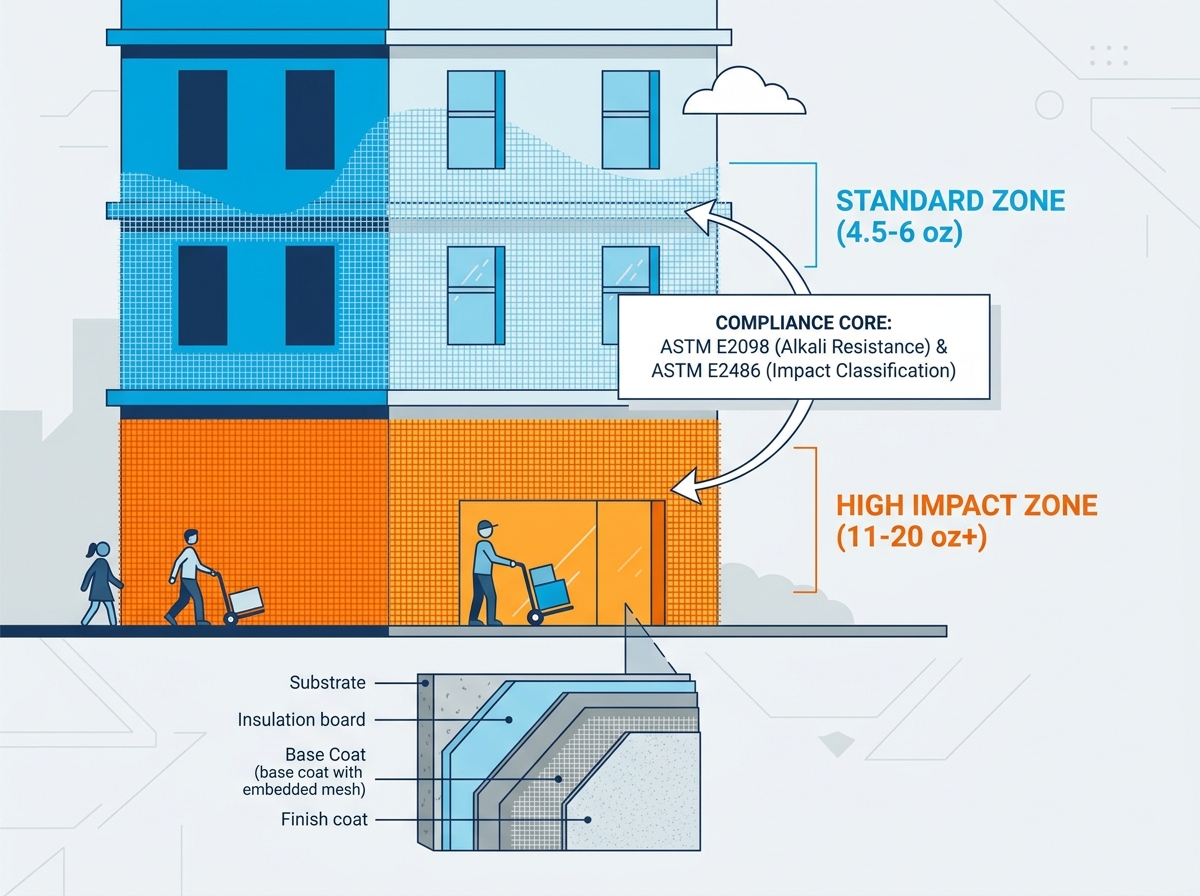
Navigating global building standards requires precision. You must map out the exact regulatory benchmarks found on technical data sheets. Specifiers cannot rely on vague marketing claims. They must look for explicit testing protocols confirming long-term durability. Two primary regulatory bodies govern these materials: ASTM International in North America and EOTA in Europe.
ASTM standard benchmarks provide the foundation for North American facade compliance. You must verify two critical testing standards. ASTM E2098 measures tensile strength retention after severe chemical exposure. Laboratories soak the material in a highly caustic sodium hydroxide solution for 28 days. The material must retain a specific percentage of its original strength to pass. ASTM E2486 establishes classifications for impact resistance. It standardizes weight requirements by testing how well the reinforced system withstands blunt force trauma.
Global sourcing teams often encounter European specifications. You must bridge the gap between ASTM requirements and ETAG 004 guidelines. ETAG 004 serves as the primary technical approval guideline for ETICS (External Thermal Insulation Composite Systems). Like ASTM standards, ETAG protocols demand rigorous alkali conditioning and impact testing. A reliable ETAG facade mesh guarantees performance parity with strict North American building codes.
Commercial assemblies also demand strict adherence to fire safety regulations. Building codes often mandate specific fire tests, such as NFPA 285, for high-rise exterior walls. High-rise structures require non-combustible or highly fire-resistant exterior layers. Specifiers must integrate a specialized fire retardant mesh when designing assemblies over certain height thresholds. These formulations utilize advanced coatings to slow flame spread and reduce smoke generation.
Testing Dimension | ASTM Standard | ETAG Guideline | Primary Objective |
|---|---|---|---|
Alkali Resistance | ASTM E2098 | ETAG 004 (Section 5) | Ensure tensile strength retention after chemical exposure. |
Impact Resistance | ASTM E2486 | ETAG 004 (Section 5.1) | Measure blunt force durability in different building zones. |
System Fire Safety | NFPA 285 (System test) | EN 13501-1 | Prevent flame propagation along the building exterior. |
Smart procurement requires a zoned application strategy. You cannot utilize a single product universally across an entire building. Matching specific weights to architectural requirements optimizes your material budget. It also guarantees necessary impact protection exactly where the building needs it most. We break down the standard solution categories below.
Standard Weight (4.5 oz - 6 oz): You should specify this lightweight option for second-story elevations. Impact risk remains virtually zero in these elevated areas. It provides essential crack prevention for thermal expansion. It remains highly flexible and easy to trowel.
High-Impact Weight (11 oz - 15 oz): You must specify this heavier grade for ground floors. It protects pedestrian walkways and high-traffic commercial zones. Shopping carts, bicycles, and normal human traffic can easily puncture standard weights.
Ultra-High Impact (20 oz+): You need this extreme protection for areas prone to heavy equipment contact. Loading docks, alleyways, and industrial delivery zones require maximum structural defense. This heavy grid prevents severe gouging and core insulation damage.
Achieving a smooth finish using heavy-duty materials presents a unique challenge. Heavy strands often telegraph through thin exterior coatings. They leave an unsightly grid pattern on the finished wall. The industry resolves this issue using the "double-layer" best practice. Installers embed the heavy or ultra-heavy grid first. Once the initial coat sets, they apply a second layer of standard weight material directly over it.
This dual-layer approach provides immense structural integrity while maintaining architectural aesthetics. The heavy base layer absorbs brutal kinetic impacts. The finer top layer smooths the surface completely. Specifying ASTM fiberglass mesh for both layers ensures perfect chemical compatibility throughout the assembly. It eliminates the grid telegraphing problem entirely.
Review pedestrian traffic flow blueprints before specifying weights.
Extend high-impact protection at least 6 feet above grade level.
Require double-layering in all specifications for ground-level public access areas.
Perfect specifications cannot overcome poor field execution. Implementation risks constantly threaten commercial facade projects. Common contractor errors easily compromise even the highest-grade materials. You must address these field conditions proactively during the pre-construction phase. Understanding the "Voice of Contractor" (VOC) realities helps prevent expensive failures.
The "smooth finish myth" represents a highly dangerous field shortcut. Contractors frequently push back against reinforcing smooth acrylic stucco. They argue the thick acrylic layer naturally resists cracking without a grid. This assumption remains fundamentally incorrect. Smooth finishes show structural movement faster than heavily textured finishes. The reinforcement layer is strictly required to distribute stress evenly. Without it, hairline cracking inevitably appears around window corners and structural joints.
Improper lapping and detailing destroy system continuity. Installers must overlap all adjoining edges by a minimum of 2.5 inches. Failing to maintain this overlap creates weak seams. These seams eventually split under thermal stress. Another critical error involves "dry-mesh embedding". Lazy contractors sometimes tack the dry fabric directly to the insulation boards using staples. They then trowel the cement base coat over it. You must never allow this. The material must be fully embedded into a wet base coat to ensure complete encapsulation.
Corner reinforcement requires meticulous attention to detail. Openings create massive stress concentrations in the building envelope. Window and door returns experience extreme sheer forces as the building settles. Installers must use pre-formed corner pieces or apply diagonal butterfly cuts. A butterfly cut involves placing an additional strip of EIFS reinforcement mesh at a 45-degree angle across the corner. This simple step prevents diagonal stress-point cracking entirely.
Common Field Error | System Consequence | Correct Implementation |
|---|---|---|
Inadequate Lapping (< 2.5 inches) | Vertical or horizontal seam splitting. | Enforce a strict 2.5-inch minimum overlap on all edges. |
Dry-Mesh Embedding | Loss of adhesion and eventual delamination. | Trowel wet base coat first, then embed material completely. |
Skipping Butterfly Cuts | Diagonal hairline cracks at window/door corners. | Install 45-degree reinforcement strips at all opening corners. |
Procurement teams need a definitive shortlisting logic for vetting manufacturers and B2B suppliers. You cannot evaluate suppliers based solely on their unit pricing. The hidden costs of poor quality control far outweigh marginal savings. A structured vendor evaluation framework protects your project from inferior imports and inconsistent manufacturing standards.
Raw material verification forms the first step in your evaluation. You must differentiate between E-glass and C-glass compositions. E-glass serves as the global industry standard for architectural applications. It offers exceptional tensile strength and durability. Conversely, C-glass represents a cheaper, lower-quality alternative. It degrades much faster under alkaline stress. You must require vendors to state their glass yarn composition clearly on all technical submissions.
Coating consistency dictates the actual lifespan of the product. The glass fibers themselves cannot resist cement alkalis. The protective acrylic or latex coating provides the actual chemical barrier. If the factory applies this coating unevenly, the raw glass remains exposed. Advise your purchasing agents to request independent lab testing. These tests must prove the consistency and thickness of the alkali-resistant coating across multiple production batches. A reliable exterior wall insulation mesh manufacturer will provide these certificates willingly.
Finally, evaluate supply chain transparency and scalability. A vendor might produce excellent samples but fail at mass production. Discuss their internal production capacity openly. Ask about lead times for custom width requirements. Pay close attention to their packaging reliability. Rolls must be shipped vertically or in reinforced cartons. Poor transit packaging leads to crushed edges. Installers cannot properly lap rolls with frayed or damaged edges.
Request written confirmation of E-glass yarn composition.
Demand third-party ASTM E2098 or ETAG 004 compliance certificates.
Review the quality control process for alkali-resistant coating application.
Verify shipping methods prevent edge-crushing during long-distance transit.
Specifying the correct reinforcement materials dictates the absolute lifespan of the entire building facade. High-alkali environments show no mercy to substandard or improperly tested components. When you strictly enforce building codes and installation best practices, you eliminate catastrophic system failures and costly structural liabilities.
Evaluating vendors based on transparent compliance provides a far more cost-effective strategy than relying on initial raw material pricing. Verifiable lab data, E-glass composition, and coating consistency guarantee long-term performance. You must implement a zoned weight strategy to optimize durability without sacrificing aesthetic finishes.
Take immediate action on your next commercial development. Encourage your specifiers and architects to demand rigorous proof of performance. Request physical product samples, updated technical data sheets, and independent compliance certificates before finalizing any procurement contracts. Protect your facade investment through uncompromising material standards.
A: No. Traditional hard-coat stucco typically relies on heavy galvanized wire lath or metal mesh for structural support due to its massive weight and thickness. In contrast, EIFS and PB (Polymer-Based) systems use highly flexible, alkali-resistant woven glass fibers designed specifically to reinforce very thin, lightweight base coats against thermal cracking and impact.
A: When compliant with strict ASTM E2098 standards and properly embedded into a compatible base coat, it lasts the entire expected lifetime of the cladding system. The protective coating shields the fibers indefinitely. However, non-compliant or unprotected glass materials can dissolve and degrade structurally in just a few months under high alkaline exposure.
A: While structurally sound, doing so is highly inefficient commercially. Using heavy grades on upper elevations wastes budget. Furthermore, it makes achieving a perfectly smooth, aesthetically pleasing architectural finish exceedingly difficult because thick yarns tend to telegraph through thin topcoats. Zoned weights are strongly recommended for optimal results.


