
Views: 0 Author: Site Editor Publish Time: 2026-07-04 Origin: Site


Maintaining structural integrity during extreme thermal events presents a serious challenge for modern construction. Wall assemblies face immense physical stress when ambient temperatures spike rapidly. Substrate failure and micro-cracking often lead to devastating fire breaches long before internal suppression systems activate. Without proper reinforcement, building exteriors risk rapid, catastrophic collapse under high heat. We rely on hidden internal components to hold broad systems together. EIFS, stucco, and magnesium oxide boards depend entirely on these internal layers for cohesion. The embedded reinforcement fabric acts as the ultimate failsafe against premature structural degradation. This article explores the precise performance mechanics behind these essential materials. You will discover a clear, evidence-based framework for evaluating standardized testing metrics. We also guide you toward sourcing reliable, code-compliant materials for commercial projects. This ensures your next build withstands rigorous regulatory scrutiny without falling for exaggerated marketing claims.
System Dependence: A fire rating (e.g., 2-hour) applies to the entire wall assembly, not the mesh alone; the mesh’s primary job is preventing premature substrate collapse.
Material Stratification: Standard 4.5oz fiberglass mesh serves baseline reinforcement needs, while high silica mesh is required for extreme continuous thermal resistance (up to 550°C+).
Compliance Reality: Selecting the right fire resistant wall mesh requires aligning material specifications with regional rebuilding codes (e.g., Wildland-Urban Interface/WUI standards).
Procurement Verification: Authentic fire retardant fiberglass mesh must be evaluated on coating consistency, post-heat tensile strength, and verifiable third-party testing, not just manufacturer claims.
Raw glass strands naturally resist high temperatures to a certain degree. They provide excellent baseline reinforcement for traditional cementitious base coats. However, the coatings applied to these fibers introduce critical vulnerabilities. Standard acrylic or alkaline-resistant sizings melt quickly under direct flame. They can even ignite under intense ambient heat. To counter this, manufacturers apply specialized intumescent or self-extinguishing polymers. These advanced chemical formulations protect the underlying woven structure. Intumescent coatings expand significantly when exposed to high heat. They form a protective char layer over the vulnerable glass strands. This chemical reaction ensures the reinforcement survives long enough to perform its core duty.
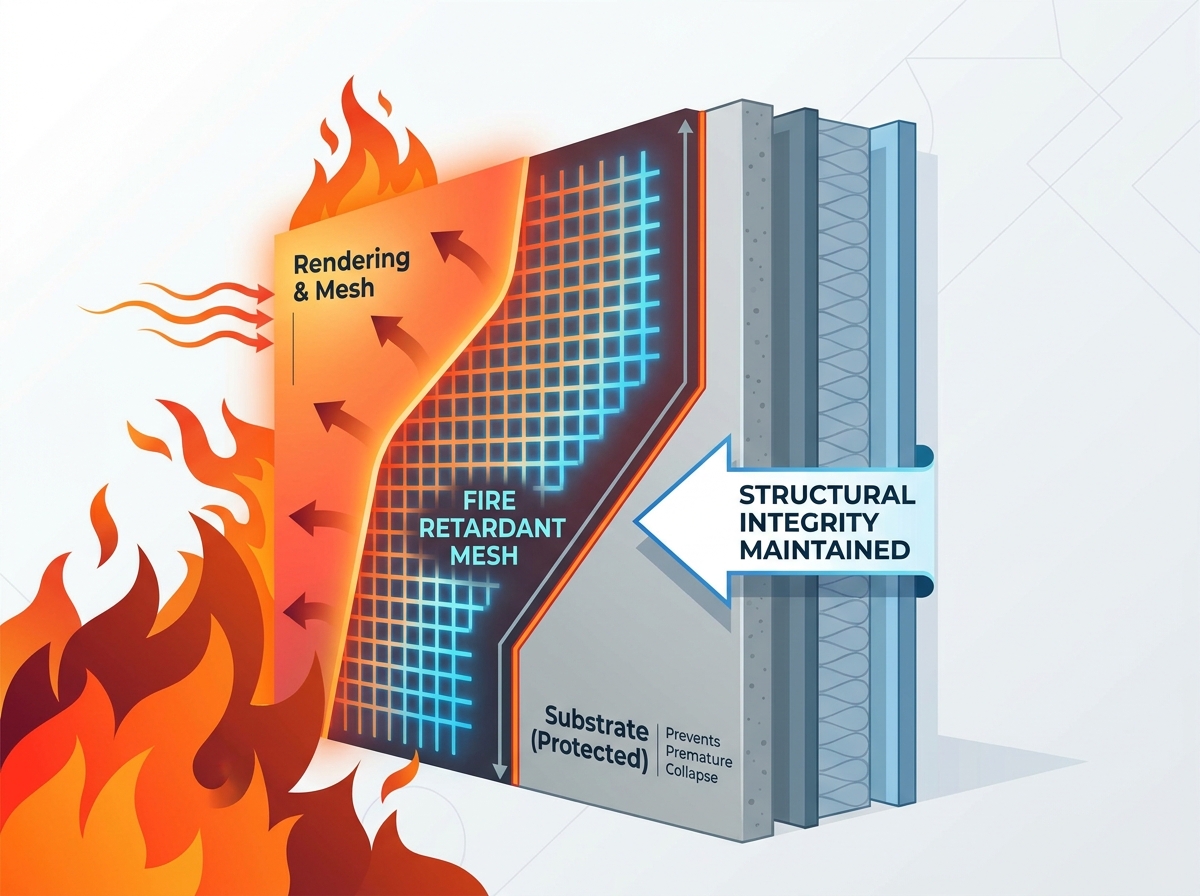
Many marketing materials advertise a "2-hour fire rating" directly on the packaging. This represents a hidden industry misunderstanding. No flexible woven fabric acts as an independently fireproof barrier. Instead, it functions purely as a structural anchor. It ensures the surrounding render holds together under severe duress. The complete wall assembly ultimately earns the coveted 2-hour rating. This system includes the interior gypsum board, mineral wool insulation, and exterior cladding. The fiberglass mesh simply prevents the outer layer from cracking and falling away.
Thermal shock occurs when exterior wall temperatures rise rapidly. Sudden heat expansion causes untreated solid surfaces to fracture immediately. The woven grid distributes this immense mechanical stress across the entire wall surface. It actively prevents spalling, bubbling, and deep surface delamination. If the outer render flakes off, oxygen rushes into the internal wall cavity. Oxygen feeds the fire, drastically accelerating structural failure. By holding the cladding together seamlessly, the reinforcement denies the fire this crucial oxygen supply.
Commercial buyers must demand rigorous, transparent testing data. You should look for frameworks closely aligned with ASTM or ISO standards. These global standards measure actual fire propagation and tensile degradation. We rely on protocols like ASTM E84 for testing surface burning characteristics. Without standardized laboratory data, you risk installing dangerous, non-compliant materials. Authentic products undergo repeated stress cycles in controlled furnace environments.
Heat tolerance benchmarks reveal true material capabilities. We look closely at standard operational temperatures versus absolute melting points. The most critical performance metric remains tensile strength retention. You must know how much mechanical strength the material keeps after prolonged heat exposure. Laboratories place samples in industrial ovens at varying intervals. Technicians then pull the baked samples apart using universal testing machines. If a woven grid loses 80% of its strength at 200°C, it fails. A true structural barrier must maintain cohesion during the initial stages of a severe thermal event.
Coating combustibility dictates another vital performance vector. Laboratories carefully measure the Smoke Developed Index (SDI) and Flame Spread Index (FSI). A certified flame resistant mesh must never act as a secondary fuel source. It cannot produce toxic smoke once the protective sizing degrades. Safe materials self-extinguish immediately when the direct flame is removed. They do not drip burning polymers onto the ground below. High SDI scores often lead to failed building inspections. They pose severe respiratory risks to building occupants during an emergency evacuation.
Choosing the correct reinforcement requires matching material properties to specific environmental risks. We use a feature-to-outcome comparison to aid procurement shortlisting. Different commercial projects demand entirely distinct levels of thermal endurance.
Standard 4.5oz fiberglass mesh serves as the everyday industry workhorse. Manufacturers treat this lightweight material with standard fire-retardant chemicals. It works exceptionally well for routine commercial EIFS applications. You will also use it heavily for basic stucco reinforcement. It performs reliably in interior fire-rated plaster assemblies. However, specifiers must recognize its inherent limitations. This specific weight proves sufficient for basic code-minimum fire resistance. Unfortunately, it degrades under sustained, direct flame exposure. It suits buildings requiring standard passive protection without extreme industrial risks.
For extreme environments, you need specialized high silica mesh. This advanced fabric contains over 90% silicon dioxide (SiO2). It excels in highly demanding industrial applications. You find it utilized in welding blankets, foundry curtains, and aerospace insulation. The performance reality is stark compared to standard alternatives. It easily withstands continuous operating temperatures of 550°C. It can survive transient exposures exceeding 1000°C without melting or shrinking. It offers superior, verified thermal barrier support where standard options fail completely.
Thermal Material Selection Matrix
Material Specification | Primary Application | Continuous Temp Resistance | Tensile Strength Retention |
|---|---|---|---|
Standard Treated 4.5oz Grid | Commercial EIFS & Stucco | Up to 200°C - 300°C | Moderate after 200°C |
Heavy Duty Alkali-Resistant | Exterior Concrete Render | Up to 300°C | High at low temps, fails >400°C |
High Silica Fabric (>90% SiO2) | Industrial Foundry & Welding | 550°C to 1000°C+ | Excellent across all ranges |
Building codes frequently evolve after major regional wildfire events. Recent shifts in resilient rebuilding guidelines strictly dictate modern material specifications. Projects in designated Wildland-Urban Interface (WUI) zones require enhanced exterior protections. You must navigate these shifting regulatory landscapes carefully during the initial design phase. Choosing an appropriate fire resistant wall mesh ensures seamless municipal compliance. It also protects building owners against costly future code violations.
We must strictly distinguish between interior wall reinforcement and external vent protection. Embedding flexible woven fabrics in wall assemblies guarantees internal structural integrity. Conversely, external attic vents require rigid, specifically sized metallic screens. Installers typically use 1/8-inch or 1/16-inch rigid wire for external vents. These precise micro-sizes prevent flying embers from entering the dry wall cavity. Internal wall reinforcement and external ember screens serve entirely different architectural functions. You cannot use soft EIFS fabrics to cover exterior ventilation points.
Specifiers must demand audit-ready documentation from all bulk suppliers. You cannot rely on verbal assurances or glossy generic marketing brochures. Request comprehensive Technical Data Sheets (TDS) and up-to-date Safety Data Sheets (SDS). Furthermore, demand recent, batch-tested fire laboratory reports from accredited testing facilities. Building inspectors and strict insurance underwriters require this rigorous paperwork. Without it, you face severe project delays or denied occupancy permits.
Sourcing construction materials globally carries inherent supply chain risks. You must identify quality control red flags early in the procurement cycle. Watch out for uneven chemical coatings during initial visual inspections. Brittle fibers indicate poor manufacturing techniques or expired sizing treatments. A glaring lack of batch-level testing data remains the biggest warning sign. Always verify that your chosen fire retardant fiberglass mesh meets advertised specifications. Cheap, unverified alternatives often fail spectacularly during live fire events.
Implementation relies heavily on strict, non-negotiable installation dependencies. Correct edge overlap represents a critical requirement for continuous protection. Installers must overlap adjacent panels by a minimum of 2.5 to 3 inches. This standard practice eliminates dangerous weak points in the continuous thermal barrier. Fire quickly exploits any gap in the protective grid. Proper embedding techniques also dictate long-term structural success. The fabric must be fully encapsulated within the wet base coat. It cannot sit loosely on the surface or touch the bare substrate.
Use a logical, step-by-step shortlisting process for B2B wholesale suppliers. First, evaluate them based on total material transparency and rapid testing access. Second, assess their supply chain reliability and historical delivery metrics. Finally, test physical material samples in your own controlled mock-up assemblies.
Always store rolls vertically in a dry, climate-controlled warehouse environment.
Trowel the base coat evenly before embedding the protective reinforcement layer.
Press the fabric firmly into the wet compound from the center outward.
Ensure trowel strokes do not cut or fray the delicate glass yarns.
Failing to overlap vertical and horizontal joints by the required three inches.
Stapling the material directly to the raw substrate before applying the base coat.
Using expired or chemically incompatible alkaline-based stuccos over sensitive fire-retardant coatings.
Leaving mesh edges exposed at termination points like window frames and door jambs.
Specifying the proper reinforcement material requires a precise technical balance. You must align expected thermal resistance with the exact wall assembly architecture. A successful fire-rated system relies on every hidden component working in total harmony. The flexible grid acts as the vital skeleton holding the protective render intact during emergencies.
Procurement teams should adopt a highly analytical approach to global sourcing. Move beyond reading basic specification sheets from unknown overseas vendors. Always request physical material samples before authorizing large wholesale orders. Submit these samples to independent laboratories for localized verification testing. Ensure your suppliers maintain strict quality control protocols.
Protect your next commercial build by consulting with qualified technical sales representatives. They can review your specific architectural plans and recommend fully compliant product lines. Reach out to verified manufacturers today to secure reliable, code-approved thermal reinforcement solutions. Proper planning today prevents catastrophic structural failures tomorrow.
A: Standard fiberglass will not burn easily, but its standard coating will melt and off-gas, causing the mesh to lose structural integrity. Fire-retardant options are required to maintain assembly strength during a fire event.
A: Fire-retardant treated standard mesh typically begins losing structural viability above 200°C–300°C as coatings fail. High silica mesh can withstand continuous temperatures exceeding 550°C and transient temperatures much higher.
A: No. The 2-hour rating is achieved by the combined materials (gypsum, insulation, cladding). The mesh prevents the outer layer from cracking and falling away, allowing the internal materials to perform their fire-blocking role.
A: For internal wall reinforcement, mesh weight (like 4.5oz) and tensile strength matter most. For external vent protection against wildland fires, tight mesh sizing (1/16-inch or 1/8-inch) is critical to block flying embers from entering wall cavities.


