
Views: 0 Author: Site Editor Publish Time: 2026-07-07 Origin: Site


Natural stone and large-format marble slabs frequently require robust reinforced backings to survive both transportation and installation. They offer unparalleled architectural beauty but often hide critical structural vulnerabilities beneath their surface. The intersection of cementitious adhesives, resin binders, and mesh backings represents a primary failure point for high-value commercial and residential tile installations. Delamination and bond failure are rarely the fault of the stone itself. Instead, they typically stem from a harsh chemical incompatibility between the stone tile backing mesh, the applied resin, and the highly alkaline environment of standard installation mortars. This technical guide breaks down the precise evaluation criteria for specifying the correct reinforcement systems. You will discover how to match materials effectively to mitigate professional liability and ensure strict standard compliance. We will show you how to eliminate costly callbacks and protect your project investments entirely.
Standard, untreated fiberglass mesh degrades rapidly when exposed to the high alkalinity of cement-based thin-sets, leading to catastrophic shear bond failures.
A true resin compatible mesh must facilitate mechanical and chemical interlocking without creating a non-porous barrier that repels installation adhesives.
Specifying a coated fiberglass mesh optimized for alkali resistance is critical for compliance with NSI (Natural Stone Institute) guidelines, particularly in wet area applications.
Mitigating field failures requires aligning the fabrication mesh, the backing resin (epoxy vs. polyester), and the setting material (polymer-modified cementitious vs. 100% solids epoxy).
Understanding why marble installations fail requires examining the chemical reactions happening beneath the tile. We constantly see projects suffer from delamination due to a combination of chemical attack and reduced surface tension. When you install marble over standard cement board or mortar beds, you initiate a slow but destructive chemical process.
Traditional Portland cement mortars create a highly alkaline environment. Upon hydration, these standard setting materials reach a pH of 12 or higher. This severe alkalinity triggers saponification. Saponification chemically attacks the silica components in standard glass fibers. It literally eats through unprotected fibers over time. Once the stone reinforcement mesh degrades, the marble loses its structural reinforcement entirely.
The resin barrier effect presents an equally dangerous threat. Quarries often apply heavy resins to agglomerated stones or fragile marble slabs. This resin creates a smooth, non-porous surface on the back of the tile. Cementitious thin-sets rely heavily on mechanical absorption. They need to grow crystalline structures into the pores of the stone to achieve a strong bond. When non-porous resin blocks this penetration, the mortar cannot anchor itself. The installation relies solely on a weak surface bond.
Failure carries massive consequences. A compromised bond on high-end marble necessitates total tear-outs. You face the replacement of unrecoverable luxury material, intense labor expenses, and severe reputational damage. Avoiding these scenarios requires addressing the backing system long before the tile reaches the job site.
Selecting the right backing material is a highly technical process. You cannot rely on generic fiberglass netting. Proper evaluation involves checking three core dimensions to ensure long-term stability.
Evaluation Dimension 1: Alkali-Resistant Coatings: A high-quality marble backing mesh must feature specialized protective coatings. Look for acrylic or styrene-butadiene rubber (SBR) latex polymer coatings. These polymers completely encapsulate the fiberglass yarns. They shield the delicate silica from aggressive pH spikes during mortar hydration.
Evaluation Dimension 2: Mesh Weight and Tensile Strength: We measure mesh weight in grams per square meter (g/m²). Standard weights range from 60g/m² to 145g/m². Heavier weights provide superior tensile strength. This proves vital for highly veined or fragile marble. However, you must exercise caution. Excessively thick mesh can complicate the thin-set bond by creating unwanted thickness and texture variations.
Evaluation Dimension 3: Weave Openness: The grid pattern requires a delicate balance. You must assess the aperture of the weave. A standard 4x4mm or 5x5mm grid usually performs best. The aperture must remain tight enough to hold the slab together. At the same time, it must stay open enough to allow setting materials to pass through. Mortar needs direct access to the raw stone surface to establish a secure bond.
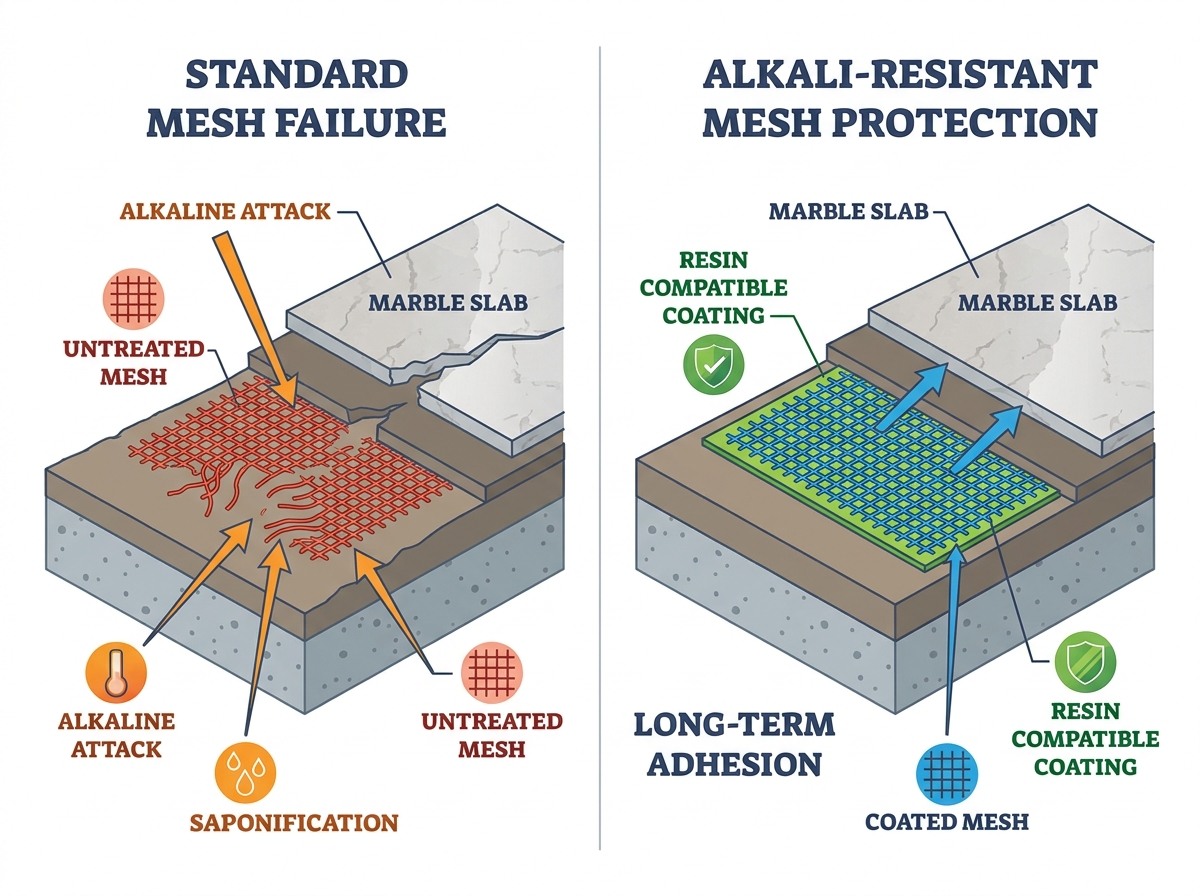
Chemical synergy dictates the success of any reinforced slab. You need a resin compatible mesh to bridge the gap between the stone and the adhesive. The mesh coating must bond seamlessly with the specific epoxies or polyester resins applied at the quarry or fabrication facility.
Fabricators generally choose between two primary binders: epoxy and polyester. Each presents distinct field implications for the tile installer.
Binder Characteristic | Epoxy Resin Systems | Polyester Resin Systems |
|---|---|---|
Structural Strength | Exceptionally high tensile strength. Ideal for highly fractured slabs. | Moderate strength. Suitable for standard reinforcement. |
Cement Adhesion | Notoriously difficult. Rejects standard cementitious mortars. | Poor to moderate. Often creates a smooth barrier. |
Required Adhesive | Requires ANSI A118.3 (100% Solids Epoxy Adhesive). | Often requires high-performance polymer-modified mortars or epoxy. |
Moisture Resistance | Excellent water resistance. Will not degrade in wet areas. | Susceptible to long-term degradation if exposed to continuous moisture. |
You must actively avoid delamination at the resin layer itself. A premium mesh absorbs the liquid resin thoroughly during the fabrication process. This absorption creates a solid, monolithic reinforcement layer. If the mesh repels the resin, it sits on top of the stone as a distinct, weak stratum. This lack of integration causes the mesh to peel away under minimal stress.
Authoritative industry bodies provide strict frameworks regarding mesh-backed stone. The Natural Stone Institute (NSI) and the Tile Council of North America (TCNA) issue specific guidelines. Following these guidelines shields you from liability during commercial installations.
Wet area installations expose backings to unique vulnerabilities. Showers, steam rooms, and pools constantly introduce water into the tile assembly. Moisture migrates steadily through grout joints over time. This water penetration re-activates the dormant alkaline compounds present in the cement setting bed. The resulting highly alkaline moisture pool accelerates the chemical degradation of any non-compliant mesh.
Using an appropriate coated fiberglass mesh prevents this moisture-driven breakdown. Specifiers must always request detailed Technical Data Sheets (TDS) from manufacturers. You need documented proof regarding performance testing. Look specifically for the 28-day alkali soak test. This test proves the mesh retains its tensile strength even after prolonged exposure to harsh pH environments. Never accept generic materials for wet-area commercial jobs without this standard documentation.
Contractors encounter unpredictable materials constantly. You need reliable field verification methods to test incoming stone deliveries. The simplest and most effective check is the water drop test.
Place a few drops of water directly onto the resin-backed surface of the marble. Observe the water's reaction closely. If the water soaks in and darkens the surface, the backing possesses some porosity. If the water immediately beads up, the resin backing is highly hydrophobic. This signals an extreme risk for cementitious bond failure.
When you identify an incompatible hydrophobic resin, you must pivot your strategy immediately. Your primary mitigation strategy involves upgrading your setting materials. You will likely need to switch to a 100% solids epoxy thin-set adhesive. Epoxy adhesives guarantee adhesion to epoxy-backed stone. They form a permanent chemical bond rather than relying on mechanical keying. While this dramatically increases both material and labor costs, it prevents catastrophic failures.
Sometimes project constraints force you to use standard polymer-modified cementitious thin-sets. In these cases, you must employ surface preparation techniques. This requires mechanically scarifying the resin back. Installers must carefully grind away the resin layer or remove the mesh entirely. This labor-intensive process exposes the raw pore structure of the stone. Exercise extreme caution during scarification. Grinding too deeply easily shatters fragile, highly veined marble slabs.
Solving adhesion problems begins far upstream. You must dictate mesh and resin types during the initial procurement and fabrication phases. Treating backing compatibility as a field installation problem guarantees schedule delays and budget overruns.
When shortlisting vendors, evaluate their quality control transparency. Require comprehensive QA/QC documentation before approving materials. Demand data detailing the specific coating percentage and alkali resistance test results. Ask for explicit resin compatibility profiles. Reputable manufacturers gladly provide this data to verify their products.
Include precise language in your Division 9 architectural specifications.
Mandate the use of alkali-resistant coatings for all natural stone mesh backings.
Specify the acceptable weight ranges (e.g., 75g/m² to 145g/m²) based on stone fragility.
Prohibit the use of water-soluble starch coatings on any fiberglass reinforcement.
Require fabricators to identify their exact resin system (epoxy vs. polyester) in writing prior to shipment.
Treating stone backing as an afterthought remains a primary driver of catastrophic tile failure.
Investing in high-grade alkali-resistant marble mesh upfront proves exponentially cheaper than mitigating bond failures post-installation.
Verify resin compatibility before materials ever arrive at the job site to avoid expensive adhesive upgrades.
Demand transparent QA/QC documentation from vendors to guarantee strict compliance with NSI and TCNA standards.
A: Cement backer boards are highly porous and aggressively draw moisture out of setting materials. When you combine this rapid moisture draw with the hydrophobic nature of resin-backed mesh, the thin-set cannot cure properly. The mortar dries out before developing a secure grip on the smooth resin. This specific combination results in an inadequate cure and exceptionally low shear strength.
A: It depends heavily on the actual resin coverage. If the mesh weave remains open and raw stone is exposed, high-performance polymer-modified mortars (ANSI A118.15) often work well. The mortar bonds to the exposed stone through the grid. However, heavily coated backs that completely seal the stone typically require specialized epoxy adhesives to guarantee a permanent bond.
A: If the mesh uses water-soluble glue, is severely degraded, or proves highly incompatible with the required setting material, removal is necessary. Mechanical abrasion or peeling becomes the only safe path forward to ensure adhesion. However, this process carries high risk. Removing the reinforcement greatly increases the chance of breaking fragile stone during handling and installation.


