
Views: 0 Author: Site Editor Publish Time: 2026-07-05 Origin: Site


On-site construction environments demand materials balancing structural integrity and rapid deployment. Heavy-duty structural systems require extremely precise handling. Job sites never tolerate slow material preparation. Improperly managed fiberglass materials often lead to excessive edge fraying. They accelerate tool wear, generate hazardous airborne particulates, and cause compounding project delays. Field teams quickly lose momentum when struggling against improperly prepped textiles.
Transitioning from pre-cut factory pieces to on-site roll processing requires a strict evaluation of material types, tooling setups, and safety protocols. You must enact careful planning to protect your workforce. Contractors face serious bottlenecks if they ignore appropriate handling methods. Implementing better tooling immediately stabilizes seam quality and reduces material waste. This approach guarantees strict compliance and absolute cost-efficiency across every single construction phase.
Selecting the correct construction fiberglass roll depends entirely on the tensile strength requirements of the substrate (e.g., concrete reinforcement vs. EIFS).
Standard utility knives fail rapidly on fiberglass; ceramic blades or specialized rotary cutters are required to maintain edge integrity and reduce on-site waste.
Properly processing cut to size mesh requires controlled environments and specific PPE to mitigate respiratory and dermal risks.
Evaluating suppliers based on pre-slit width options can eliminate up to 40% of on-site cutting labor.
Choosing the right reinforcement material dictates the lifespan of your installation. Builders rely heavily on fiberglass mesh to bridge structural gaps and distribute stress. However, different manufacturing methods create drastically different behavioral profiles in the field.
Woven mesh offers superior multidirectional tensile strength. Manufacturers weave the glass threads into a precise grid. This grid pattern absorbs movement. It remains the absolute best choice for Exterior Insulation and Finish Systems (EIFS), stucco, and plaster reinforcement. In these applications, flexibility and crack prevention remain paramount. The woven structure allows base coats to push through the gaps, locking the reinforcement directly into the wall assembly.
Conversely, chopped strand mesh features a random fiber orientation. Factories bond short glass strands together using specialized styrene binders. This creates a dense, non-woven mat. Explain the resin-absorption capabilities here: the random orientation aggressively pulls in liquid resins. It performs best for rigid composite repairs, marine construction, and heavy-duty structural backing. It lacks flexibility but provides immense static rigidity once fully cured.
Material Profile Comparison Chart
Feature | Woven Mesh | Chopped Strand Mesh |
|---|---|---|
Fiber Orientation | Structured Grid (Warp and Weft) | Randomly Scattered |
Flexibility | High | Low |
Primary Use Case | EIFS, Stucco, Plaster | Marine Repairs, Rigid Backing |
Resin Absorption | Moderate | Very High |
Concrete and Portland cement create extremely high-pH environments. Unprotected glass fibers will quickly dissolve when exposed to these alkaline conditions. You must evaluate the necessity of acrylic or latex coatings on your materials.
Standard uncoated fiberglass degrades rapidly inside wet cementitious mixes. To prevent this chemical breakdown, quality mesh receives a specialized polymer bath during manufacturing. This alkali-resistant coating forms a protective barrier. It ensures the structural grid survives the curing process and maintains its tensile strength over decades. Always verify the coating percentage before applying mesh to highly alkaline substrates.
Proper material sizing prevents excessive field waste. Contractors often face a choice between standard 38-inch master rolls and custom narrow-width tapes. Your decision heavily impacts labor hours. Using a standard construction fiberglass roll offers bulk pricing advantages. However, it requires extensive on-site processing to fit narrow joint seams.
You must calculate accurate waste-to-yield ratios. Analyze your project blueprint. Determine the linear footage of joints versus broad wall applications. If 70% of your project requires 4-inch joint reinforcement, buying master rolls forces your crew to slice massive amounts of material by hand. In these scenarios, ordering narrow pre-slit tapes drastically reduces labor and eliminates uneven field cuts.
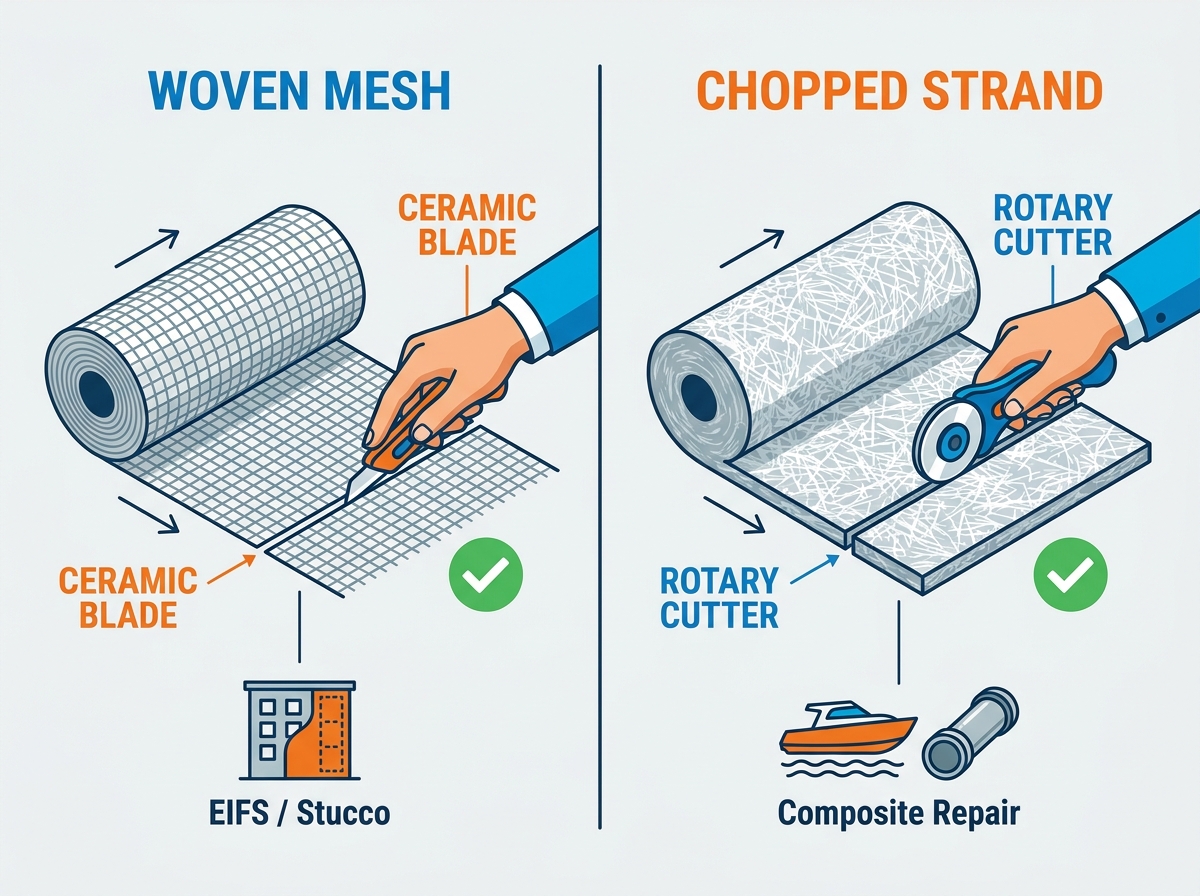
Standard carbon steel blades fail miserably against abrasive glass fibers. Field workers frequently grab cheap utility knives to slice fiberglass cutting rolls. This constitutes a massive mistake. The glass strands act like sandpaper, dulling ordinary steel after just a few passes.
A dull blade causes severe material pulling. Instead of cleanly severing the threads, the blade drags them out of alignment. This compromises structural seams and creates messy, frayed edges. Frayed edges protrude through stucco finish coats, creating unacceptable visual defects. Upgrading your tooling stack eliminates these costly reworks.
Modern material science offers superior alternatives to carbon steel. Assess the return on investment (ROI) of ceramic micro-blades. Ceramic materials boast incredible hardness. They retain their sharp edge up to ten times longer than traditional steel knives.
These blades provide excellent results for on-site construction mesh. They easily slice through insulation backing and light-duty reinforcements. Furthermore, ceramic blades feature a unique micro-edge. This design significantly minimizes accidental laceration risks for your workforce. They represent an ideal manual tool for precise, low-volume detail work around doors and windows.
High-volume commercial projects demand automated solutions. Electric rotary cutters easily handle multi-layer fiberglass applications. You should specifically evaluate tools utilizing octagonal blades. Unlike perfectly round blades, octagonal designs pull the material slightly downward during the cut. This prevents the slick glass threads from sliding away.
Speed control remains critical. High-speed friction generates immense heat. If you run a rotary cutter too fast, you risk localized melting. The acrylic or latex coatings on the mesh will fuse together, ruining the flexibility of the material. Detail the importance of adjustable speed settings. Dialing down the RPMs ensures a cold, clean slice through heavy-duty rolls.
Even the sharpest blade fails if the material shifts. Proper stabilization ensures perfect 90-degree square cuts. You must tension the fabric correctly before initiating any cut. Implement these best practices for stabilization:
Construct a dedicated cutting table topped with a self-healing mat.
Install a heavy steel straightedge to clamp the material firmly across its entire width.
Unroll the fabric smoothly, ensuring no diagonal wrinkles form along the weave.
Apply firm downward pressure on the straightedge before engaging your cutting tool.
Draw the blade steadily without stopping mid-cut to prevent jagged threading.
Honest assessments of job site dust generation remain crucial. Cutting raw glass threads releases microscopic airborne shards. Many manufacturers advertise "dust-free" material processing, but practical field experience tells a different story. Zero dust generation represents a myth in active construction environments.
You must move beyond false claims and implement practical dust-capture strategies. For centralized cutting stations, downdraft tables provide the best defense. They actively pull heavy particulates downward away from the operator's breathing zone. If your crew cuts material directly on the scaffold, mandate localized HEPA vacuums. Attach the vacuum nozzle directly adjacent to the cutting shears to capture debris at the source.
Processing techniques must adapt to the chemical state of your materials. Dry-cutting requires sharp blades and intense dust management. However, cutting techniques change drastically if you process the mesh in-situ after wetting it out. Applying epoxy or polyester resins transforms the fabric into a sticky, dense matrix.
Wet cutting demands completely different tooling. Rotary blades quickly gum up and stall when exposed to wet epoxy. Instead, use specialized serrated shears. You must clean these shears immediately with solvent before the resin kicks and cures. Timing matters immensely. You should trim wetted mesh during its "B-stage" or gel phase. The material holds its shape but remains soft enough to yield easily to a utility blade.
Protecting your workforce requires uncompromising safety standards. OSHA guidelines provide the baseline requirements for handling airborne glass particulates. Every operator must wear N95 or P100 half-face respirators. Simple paper masks do not block microscopic glass shards effectively.
Dermal protection prevents severe discomfort. Address user-generated feedback regarding skin irritation, commonly known as the "glass itch." Workers handling heavy rolls should wear nitrile gloves underneath heavy leather work gloves. The nitrile stops microscopic fibers from penetrating into the pores. Furthermore, mandate Tyvek sleeves or disposable coveralls. Verifiable prevention methods include applying specialized barrier creams before shifts. Instruct workers to utilize cold water washing at the end of the day. Warm water opens the pores, trapping glass fibers deeper into the skin.
Do not buy reinforcement materials blindly based on price. You must rigorously analyze the Technical Data Sheets (TDS) provided by the manufacturer. What should you look for in this documentation?
First, examine the tensile strength. The TDS must list separate breaking strengths for the warp (vertical) and weft (horizontal) threads. Second, verify the weight per square yard. Heavier meshes offer higher impact resistance but become harder to wrap around corners. Finally, check the coating percentage. Premium alkali-resistant products typically feature a coating weight of 15% to 20% of the total mass. Anything lower risks rapid degradation in cementitious applications.
Labor costs frequently dwarf material costs on a job site. You must assess the operational value of suppliers offering specialized configurations. Vendors who supply pre-cut or scored cut to size mesh drastically reduce your field labor. Receiving pre-slitted widths for window corners or foundation joints eliminates measurement errors. Crews simply unroll and embed the perfectly sized tape. This lean approach accelerates the installation phase and minimizes scrap waste.
High-quality manufacturing matters little if the product arrives damaged. Assessing how vendors package heavy rolls reveals their logistical competence. Heavy master rolls endure significant abuse during transit.
If a supplier fails to use reinforced cardboard or plastic inner cores, the sheer weight of the glass fabric will cause crush damage. A crushed core renders the final yards of the roll completely unusable on automated dispensing racks. The roll will bounce and bind during unwinding. Always specify rigid cores and vertical pallet stacking when negotiating with suppliers.
Vendor Evaluation Criteria Table
Evaluation Metric | Standard Vendor | Premium Vendor |
|---|---|---|
TDS Transparency | Basic Weight Only | Full Warp/Weft & Coating Data |
Custom Sizing | Master Rolls Only | Pre-slit to exact dimensions |
Packaging Quality | Soft Paper Cores | Heavy-duty Plastic/Rigid Cores |
Alkali Coating | < 10% mass | 15% - 20% mass |
Processing fiberglass materials on-site remains a complex exercise in risk management and tool optimization. Success requires moving beyond cheap utility knives and adopting professional-grade ceramic blades or adjustable rotary cutters. You must match the specific fiber orientation to your substrate while rigorously enforcing OSHA-aligned PPE standards. Proper vendor selection further reduces site labor through optimized custom roll sizing.
Take immediate action by auditing your current on-site blade consumption and material waste percentage. Before upgrading your entire material spec or tooling stack, request small test samples of both chopped strand and woven products. This localized testing guarantees total on-site tool compatibility. You will protect your profit margins and ensure durable, pristine construction seams.
A: Use the "score and snap" equivalent for mesh. First, embed the material smoothly into the wet base coat. Before the cementitious cure finalizes, slice lightly along your desired line using a fresh utility blade or a specialized sharp trowel edge. Pull the excess material away cleanly.
A: Yes. Chopped strand features heavy styrene binders. These binders quickly gum up electric rotary blades through friction heating. You must process chopped mat using heavy-duty industrial shears or specialized serrated manual blades to prevent the tool from binding.
A: Apply heavy-duty masking tape precisely along the intended cut line prior to slicing. Cut directly down the center of the tape. Alternatively, utilize specialized electric hot-knife cutters on synthetic-coated meshes. The heat melts the coating, instantly sealing the edge and preventing thread unraveling.
A: Ceramic blades have limitations. They excel at slicing single-layer, lightweight mesh and insulation facing smoothly. However, they generally lack the mechanical leverage required to push through thick, multi-axial weaves or heavy chopped strand mats without snapping under pressure.


