
Views: 0 Author: Site Editor Publish Time: 2026-07-06 Origin: Site


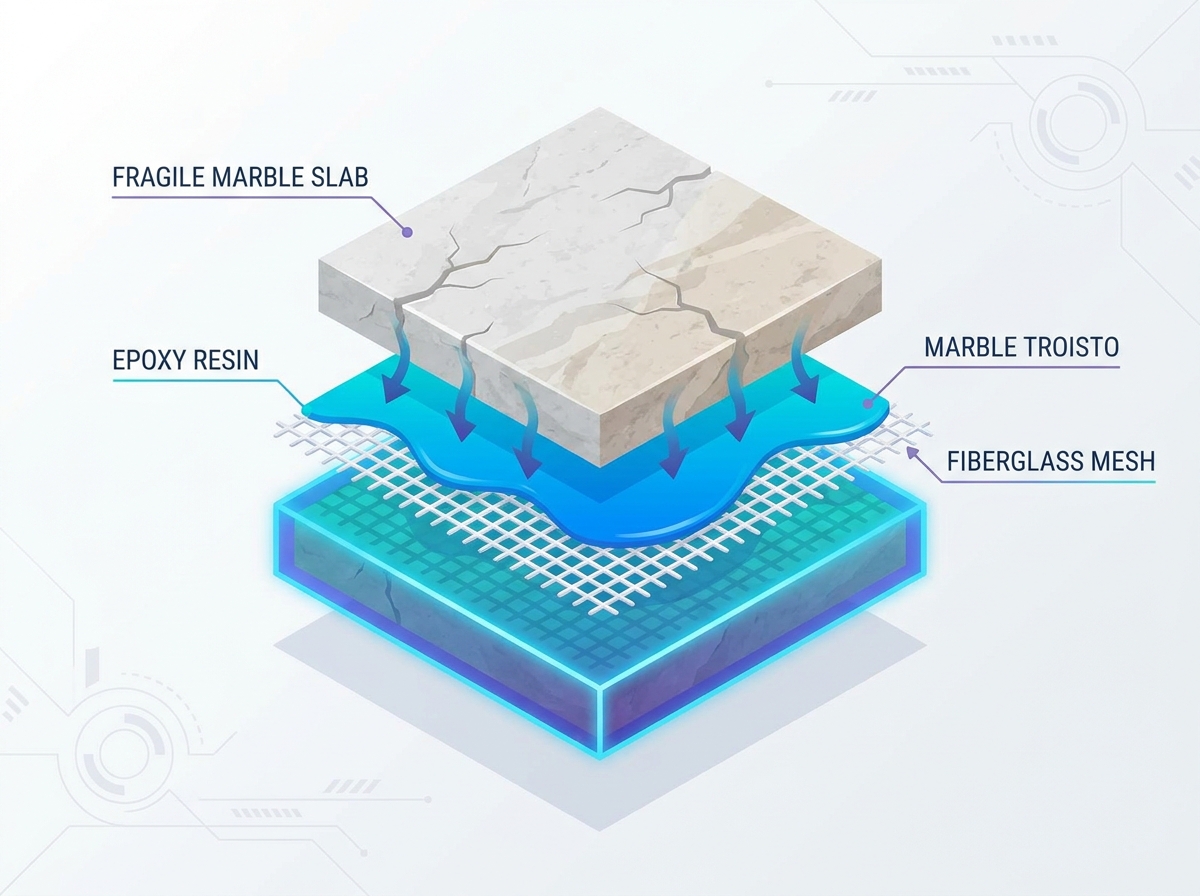
Processing natural stone carries immense financial risk. Fragile marble slabs often crack during transport, fabrication, or final installation. These breakages directly destroy project margins and slash overall fabrication yield. To mitigate these losses, applying a high-quality marble backing mesh serves as non-negotiable structural insurance for high-value stone. It reinforces the fragile veining, keeping valuable inventory intact throughout the entire processing lifecycle.
You cannot just hunt for the lowest price when securing this material. Choosing the correct mesh involves a rigorous technical evaluation of sizing, weight, tensile strength, and resin compatibility. We will explore exactly how to match mesh specifications to your stone profiles for maximum stability. By the end of this guide, you will know exactly how to evaluate, test, and source the perfect reinforcement solution for your production facility.
Weight determines application: Mesh weight (typically 60g/m² to 110g/m²) must align with the stone's fragility and thickness.
Resin compatibility is critical: Effective reinforcement requires optimal epoxy penetration through the mesh to prevent delamination.
Alkaline resistance extends lifespan: Uncoated mesh degrades when exposed to cementitious adhesives during final installation; AR (Alkaline Resistant) coatings are mandatory.
Vendor consistency matters: Evaluating a supplier requires testing for uniform weave, coating quality, and dimensional stability under tension.
Natural stone inherently contains micro-fissures and hidden fault lines. These invisible flaws often trigger catastrophic failures during intensive CNC routing, edge polishing, or routine warehouse handling. Machine vibrations easily split unreinforced stone along its natural veins. By treating the back of the stone early in the process, fabricators lock the structural integrity into place. This preventative measure drastically reduces processing errors.
Yield optimization directly drives profitability in any stone processing plant. Applying fiberglass marble backing mesh immediately after cutting the raw block maximizes your usable square footage. It binds the fractured zones together securely. You recover slabs you might otherwise discard as scrap. When you convert more of the raw block into sellable slabs, your operational efficiency improves significantly.
Logistics present another major hazard for large stone formats. Vibrations during shipping easily snap unsupported slabs inside shipping containers. Forklift handling also introduces severe flexural stress. Proper reinforcement exponentially increases the flexural strength of the slab. You face fewer breakage claims and reduce liability during heavy transport. Structurally sound slabs arrive at the job site ready for seamless installation.
No single mesh specification works universally for every stone type. You must carefully match the physical specifications to the distinct profile of the slab. Using an improper weight or weave often leads to inadequate support or excessive resin consumption.
The weight of the mesh directly corresponds to the level of rigidity it provides. Fabricators categorize mesh into distinct weight classes based on the intended application.
60g - 75g/m²: Ideal for standard, relatively stable stone or basic mosaic backing. It provides essential stabilization without adding unnecessary bulk to the slab back.
80g - 90g/m²: The widely accepted industry standard for commercial marble slab reinforcement. It perfectly balances flexibility, ease of application, and heavy-duty structural support.
100g+ /m²: Reserved exclusively for highly fractured materials like onyx, or ultra-thin oversized slabs requiring maximum rigidity to prevent shattering.
Cell size dictates how well epoxy flows through the fiberglass barrier. We typically evaluate 4x4mm versus 5x5mm cell sizes during procurement. If the grid remains too tight, it impedes resin bonding to the stone surface. The resin sits on top of the mesh instead of penetrating the fissures. If it runs too loose, it compromises the overall structural support, leaving wide gaps vulnerable to bending forces.
Standard industry widths range from 1.5m to 2m. Selecting the correct width minimizes overlap waste on jumbo slabs. Excessive overlapping creates uneven thickness on the back of the stone. This uneven surface complicates the final thinset application and leveling process during installation. Custom widths help factories optimize their automated resin lines.
Mesh Weight (Grammage) | Typical Grid Size | Primary Application | Resin Consumption Level |
|---|---|---|---|
60g - 75g/m² | 4x4mm / 5x5mm | Stable marble, mosaics, tiles | Low |
80g - 90g/m² | 5x5mm | Standard slabs, commercial processing | Medium |
100g - 110g/m² | 5x5mm / 6x6mm | Onyx, heavily fissured stone, ultra-thin slabs | High |
Evaluating materials goes far beyond checking the stated weight on a technical sheet. Real-world performance depends heavily on chemical resilience and mechanical stability. You must scrutinize these factors closely.
Bare fiberglass suffers from severe chemical vulnerability. It degrades rapidly when exposed to the high alkalinity of cement-based thinsets. A quality stone backing net must feature a verified polymer or latex coating. This specialized coating guarantees the fibers survive in harsh alkaline environments during final installation. Without it, the structural reinforcement dissolves away over time.
Bidirectional stability ensures the mesh does not stretch or deform during manual or automated application. You should request baseline metrics for acceptable breaking strength from your manufacturer. High tensile strength keeps the structural reinforcement rigid across both the warp (lengthwise) and weft (crosswise) axes. Weak mesh warps under tension, creating wrinkles.
The mesh must lay completely flat against the stone. It needs to absorb epoxy evenly without repelling the liquid or trapping air bubbles. Trapped air creates isolated weak spots, which frequently cause downstream delamination. Excellent wettability allows the resin to fully encapsulate the glass fibers. When the sizing agents on the mesh interact perfectly with your chosen epoxy, you achieve a monolithic, inseparable bond.
Even the best materials fail if applied incorrectly. The factory floor environment dictates the final bonding success. Managing these variables requires strict operational protocols.
Proper adhesion requires an immaculate surface. You must extract all dust and completely remove moisture from the slab back before applying the marble fiberglass mesh.
Use industrial vacuums to remove fine silica dust from the surface.
Deploy infrared heaters to drive out latent moisture trapped inside the stone pores.
Ensure the stone surface temperature matches the resin manufacturer's recommendations.
Any residual dust creates a physical barrier against the epoxy. Moisture reacts adversely with the resin, causing it to foam, turn cloudy, or fail completely.
Ambient temperature dictates your working time. Hot factory floors accelerate the epoxy curing process, leaving workers less time to smooth the mesh. Resin viscosity must match the grid size you selected. A thick resin struggles to penetrate a tight 4x4mm weave. Furthermore, you face a high risk of "dry spots" if you miscalculate the resin-to-mesh ratio. Insufficient resin starves the mesh, leaving loose, unbonded patches.
Standard curing times vary based on the specific resin chemistry and environmental conditions. You must establish strict stacking protocols. Moving slabs too early disturbs the delicate curing bond. Stacking slabs face-to-back before full cure leads to grid-pattern transfer. Worse, wet resin can seep through the mesh and permanently bond two expensive slabs together on the A-frame.
Sourcing reliable materials requires strict validation before you sign any bulk contracts. You cannot afford batch-to-batch inconsistencies in your production line. Poor quality mesh halts automated resin lines and ruins valuable inventory.
Procurement teams must request A4-sized or 1-meter samples from potential vendors. Do not rely solely on technical data sheets. Use these samples to conduct localized pull-tests. Apply your standard epoxy to a scrap piece of stone, embed the sample, and let it cure. Attempt to peel it off. This practical testing proves the product works harmoniously in your specific facility.
Visual inspection reveals significant details about manufacturing standards. Instruct your buyers to check for several key red flags.
Look for fraying edges along the sides of the roll, which cause tangles on automated machines.
Inspect for inconsistent coating application. Stiff spots versus soft spots indicate poor manufacturing control.
Verify accurate weight-per-square-meter claims using a precision scale. Many cheap suppliers under-deliver on the actual glass content, padding the weight with excessive, low-quality resin sizing.
Consistent bulk availability ensures steady production without expensive downtime. Assess the vendor's packaging standards. Standardized, reinforced packaging prevents crushed rolls during rough sea transit. Deformed rolls will not lay flat on the stone. Finally, you must confirm the factory guarantees consistent lot-to-lot manufacturing to protect your ongoing processing quality.
Specifying the right marble back-netting mesh requires a precise balance of weight, weave, and chemical resistance. You safeguard your valuable inventory only when you respect these technical parameters. Treating reinforcement as a cheap commodity invites catastrophic failure during fabrication and transit.
We strongly urge decision-makers to prioritize rigorous physical sample testing. Always test any new mesh with your specific preferred epoxies before committing to bulk container orders. Compatibility in the lab does not always translate to success on a dusty, humid factory floor.
Take proactive steps today to protect your natural stone margins. Request comprehensive technical data sheets (TDS) from your suppliers. Compare alkaline resistance specifications carefully, and order physical testing samples for immediate trial on your fabrication line.
A: The standard weight typically ranges from 75g/m² to 90g/m² for most commercial applications. This range balances flexibility and structural support perfectly. However, you might require heavier mesh, exceeding 100g/m², for highly fragile stones, heavily fissured onyx, or ultra-thin oversized formats.
A: No, you should not remove it. High-quality, alkaline-resistant mesh is explicitly designed to remain permanently attached to the slab. It acts as a structural backbone and bonds safely with standard cementitious installation adhesives, ensuring long-term stability on the wall or floor.
A: Grid dimensions directly control resin flow. Larger gaps like 5x5mm allow thicker, high-viscosity epoxies to penetrate easily down to the stone surface. Conversely, tighter weaves like 4x4mm perform better when using low-viscosity resins on highly fractured surfaces, providing denser localized support.
A: Absolutely not. Standard bare E-glass degrades rapidly when exposed to alkaline environments. Cement-based thinsets used during final installation destroy unprotected glass fibers chemically. An alkaline-resistant (AR) coating is mandatory to ensure the reinforcement survives and functions throughout the lifespan of the installation.


