
Views: 0 Author: Site Editor Publish Time: 2026-11-05 Origin: Site


Concrete delivers massive compressive strength but fails under tension. This physical reality makes it highly vulnerable to plastic shrinkage and thermal cracking during the curing phase. Traditional secondary reinforcement relies on welded wire fabric or light steel rebar. These metallic options bring heavy operational baggage. They rust, require heavy transport, and often represent engineering overkill for basic crack control. Leaving flatwork or facades unreinforced is not an option, as it guarantees premature degradation and aesthetic failure. You need a reliable alternative. Determining if fiberglass mesh for concrete reinforcement fits your project requires strict technical evaluation. We must assess its mechanical limits, verify chemical compatibility in harsh cement environments, and pinpoint exactly where it outperforms steel.
Not a Structural Substitute: Fiberglass mesh is engineered for secondary reinforcement and shrinkage crack control; it does not replace steel rebar for primary structural load-bearing applications.
Chemical Compatibility is Non-Negotiable: Only alkali resistant fiberglass mesh (AR fiberglass mesh) can survive the highly alkaline environment (pH 12-13) of Portland cement without dissolving over time.
Optimal Deployment Zones: Highly effective in non-load-bearing flatwork, precast architectural panels, EIFS (Exterior Insulation Finishing Systems), and cementitious screeds.
Specification Dictates Success: Selecting the correct mesh weight and aperture (e.g., 4x4mm fiberglass mesh for plaster vs. 300 g/m² for heavy-duty crack bridging) is critical for aggregate interlock and long-term durability.
Clarifying the technical boundary between primary and secondary reinforcement dictates project success. Primary reinforcement uses heavy steel rebar to bear structural loads, resist bending moments, and prevent catastrophic collapse. Secondary reinforcement focuses entirely on holding the concrete matrix together during the vulnerable curing phase. It mitigates internal stresses caused by volume changes as water evaporates and the slab shrinks.
During the plastic settlement and drying shrinkage phases, fiberglass reinforcing mesh acts as a distributed tension-absorbing network. It intercepts micro-stresses before they coalesce. By distributing these forces across thousands of individual glass filaments, the mesh prevents micro-cracks from propagating into visible macro-cracks. This keeps the surface monolithic and blocks water ingress. It is particularly effective at mitigating re-entrant corner cracks and surface crazing that plague large flatwork pours.
You cannot use mesh to provide the tensile yield strength required for suspended slabs, heavy-traffic bridge decks, or structural columns. It lacks the rigidity and mass to transfer heavy dynamic loads. Attempting to substitute engineered steel with flexible mesh in a load-bearing scenario results in immediate deflection and structural failure. The mesh is a surface stabilizer, not a load-bearing skeleton.
Portland cement hydration generates calcium hydroxide. This creates a highly alkaline environment with a pH ranging from 12 to 13. Standard E-glass fibers react poorly to this extreme alkalinity. The hydroxide ions attack the silica network within the bare glass filaments. This chemical reaction breaks down the molecular structure, leading to rapid embrittlement and complete loss of tensile strength within a few months.
To survive this aggressive environment, the reinforcement must be chemically shielded. You must use alkali resistant fiberglass mesh. Manufacturers produce alkali-resistant variants using glass formulations containing zirconium dioxide (zirconia). They further encapsulate these fibers in specialized acrylic or styrene-butadiene coatings. This dual-layer defense mechanism protects the underlying glass filaments from alkaline attack. It ensures the mesh maintains its structural integrity for the entire lifespan of the concrete element, even during the intense heat and pH spikes of the initial 28-day curing cycle.
Driveways, residential sidewalks, patio slabs, and interior floor screeds represent the ideal deployment zones for mesh reinforcement. In these applications, thermal expansion, freeze-thaw cycles, and surface cracking are the primary threats to longevity. The concrete rests entirely on compacted subgrade. It does not need to span open spaces or carry suspended loads.
Replacing traditional welded wire fabric with fiberglass eliminates all corrosion risks. Wire mesh often ends up exposed at the surface or edges of a slab. This exposure leads to unsightly rust staining and eventual spalling. Fiberglass completely removes this failure point. Because fiberglass does not require the deep concrete cover necessary to protect steel from oxidation, contractors can safely reduce the overall concrete profile thickness in specific screed applications. This reduction saves significant material volume and lowers project costs. Note that mesh does not replace the need for proper control joints; it simply holds the concrete together between those joints.
Exterior rendering systems endure constant thermal cycling, wind loads, and impact stresses. Utilizing fiberglass mesh for cement plaster is standard practice to prevent surface cracking, improve impact resistance, and stabilize the rendering layers over rigid insulation boards. The mesh must be fully embedded in the base coat, not visible, and overlapped by at least 2.5 inches at all seams.
Sizing specifications dictate the success of the facade. Standard aperture sizes, particularly 4x4mm fiberglass mesh, are engineered specifically for base coat applications. This exact grid spacing allows optimal mortar penetration. The cementitious material easily pushes through the voids, encapsulating the mesh and bonding securely to the substrate. If the grid is too tight, the mortar cannot penetrate. This creates a weak shear plane that leads to delamination. If the grid is too large, the mesh fails to distribute localized impact stresses effectively.
Subterranean environments face constant hydrostatic pressure and shifting soils. These high-stress, moisture-prone environments require robust impact-resistant facade systems or heavy-duty basement waterproofing membranes. Standard light-duty mesh will tear under active foundational movement.
For positive-side waterproofing applications, integration of heavy-duty mesh (weighing between 200 and 300 g/m²) with liquid-applied elastomeric membranes is required. The heavy mesh acts as a flexible backbone for the coating. It bridges existing micro-cracks in the foundation wall and prevents new cracks from telegraphing through the waterproofing layer. This system prevents hydrostatic pressure failures and basement flooding.
The precast industry relies heavily on thin-walled, non-load-bearing structures, architectural planters, and decorative facades. Traditional steel reinforcement is highly problematic in these elements. Building codes mandate specific depths of concrete cover to protect the steel from chloride-induced corrosion. This cover requirement forces panels to be thick and heavy.
Switching to fiberglass reinforcement allows precasters to achieve significant weight reduction. Because fiberglass will never rust, the protective concrete cover can be reduced to the absolute minimum required for aggregate binding. This results in thinner, lighter architectural panels. These panels are easier to transport, require less heavy machinery to hoist, and impose lower dead loads on the building's primary superstructure.
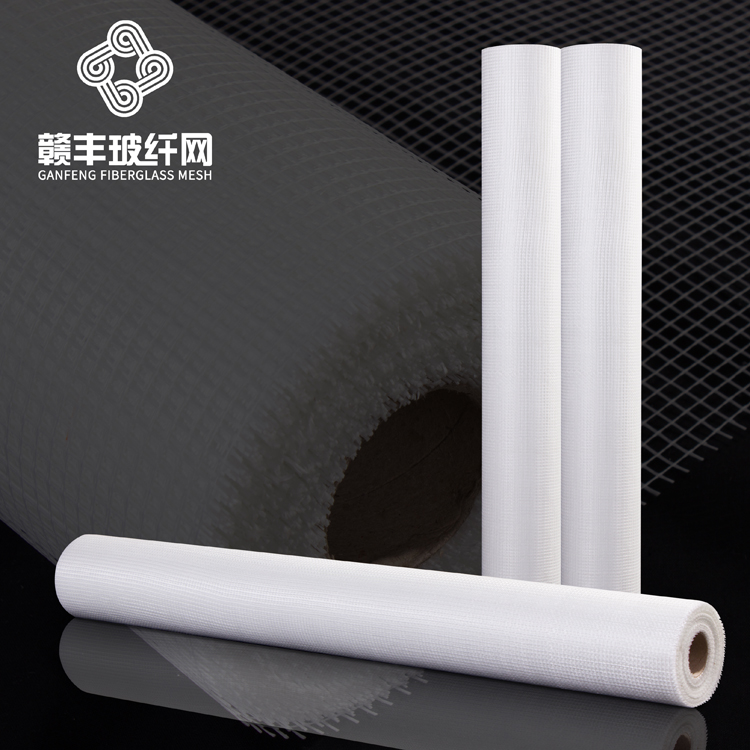
Contractors often debate the merits of macro-synthetic polypropylene fibers mixed directly into the concrete truck versus surface-applied fiberglass mesh. Polypropylene fibers provide excellent three-dimensional, isotropic reinforcement throughout the entire slab. They are ideal for reducing plastic shrinkage across the full depth of the pour. However, mixed-in fibers do not provide continuous, localized tensile support at the surface where bending stresses and thermal cracks originate. Fiberglass mesh, placed specifically in the upper third of the slab, provides a continuous, unbroken plane of tensile resistance exactly where surface cracks attempt to open.
Basalt and carbon fiber meshes represent the high-end alternatives. Basalt offers superior high-temperature resistance, while carbon fiber delivers unmatched tensile modulus. These advanced fibers come at a steep premium. For standard construction, flatwork, and EIFS, the cost-benefit analysis heavily favors standard AR fiberglass mesh. It provides more than enough tensile strength for secondary crack control at a fraction of the cost of carbon or basalt alternatives.
Reinforcement Type | Primary Mechanism | Corrosion Risk | Best Application Zone |
|---|---|---|---|
Steel Welded Wire Fabric | Continuous planar tension | High (Rust/Spalling) | Heavy slabs, structural decks |
Polypropylene Fibers | Isotropic 3D dispersion | Zero | Deep crack prevention, volumetric shrinkage |
AR Fiberglass Mesh | Continuous planar tension | Zero | Surface crack control, EIFS, thin screeds |
Carbon Fiber Mesh | High modulus planar tension | Zero | Structural retrofitting, extreme load environments |
Using fiberglass mesh for construction requires precise specification matching. You cannot grab a random roll off the shelf and expect it to perform across all cementitious applications.
Selecting the correct material requires categorizing mesh by its area weight. This weight directly correlates to its tensile capacity and intended use. Using an undersized mesh leads to rupture under stress, while an oversized mesh wastes capital and complicates troweling.
Weight Category | Density Range | Primary Field Application |
|---|---|---|
Light-Duty | 45 - 90 g/m² | Fine interior plastering, delicate architectural detailing, drywall finishing. |
Standard-Duty | 145 - 160 g/m² | Exterior stucco, EIFS base coats, standard cementitious rendering. |
Heavy-Duty | 200 - 300+ g/m² | Concrete flatwork, high-impact ground floor facades, heavy crack-bridging. |
Project managers must match the specified tensile strength to the anticipated thermal and mechanical stress of the specific project. A driveway slab exposed to freezing winters requires a significantly higher tensile rating than an interior decorative wall.
The mesh aperture must interact seamlessly with the concrete mix design. The grid size dictates how well the cement paste and aggregates flow through the reinforcement plane. If the grid is mismatched to the mix, the mesh acts as a sieve. It separates the paste from the aggregate and creates a weak, delaminating layer.
Ensure the grid size is large enough to allow the maximum aggregate size to pass through easily. For fine stucco, a 4x4mm or 5x5mm grid is optimal. For concrete flatwork containing 3/8-inch pea gravel, a much larger aperture (e.g., 10x10mm or 25x25mm) is strictly required. This ensures a monolithic pour and prevents the mesh from floating on top of the coarse aggregate.
Visual inspection cannot confirm alkali resistance. Contractors must verify the chemical composition and coating quality through manufacturer documentation. High-quality mesh requires a minimum zirconia content exceeding 16% within the glass melt, combined with a robust polymer coating.
Procurement teams must demand compliance with ASTM or equivalent international standards for alkali resistance in glass fiber products. Testing protocols usually involve soaking the mesh in a sodium hydroxide solution at elevated temperatures for 28 days and measuring the retained tensile strength. Acceptable mesh will retain the vast majority of its original strength after this accelerated aging test.
Comparing the initial material cost of fiberglass mesh against steel wire fabric often shows fiberglass at a slight premium or at parity, depending on market fluctuations. The true value emerges when calculating the fully burdened installed cost. Fiberglass mesh delivers massive long-term savings derived from reduced labor hours, significantly lower transportation costs, and zero corrosion-related maintenance over the lifespan of the slab.
The operational advantages on large job sites are undeniable. Steel wire mesh requires heavy trucks for delivery, bolt cutters to size, and hours of manual labor to tie intersections. It holds memory from the roll and constantly fights the installation crew. A sheet of welded wire fabric requires two men to carry and position.
Fiberglass changes the workflow entirely. It is lightweight, easily carried by a single worker, cuts cleanly with standard utility knives, and requires no tying. It lays flat immediately. This ease of handling significantly accelerates project timelines, allowing concrete crews to prep and pour larger areas in a single shift.
Traditional steel inevitably oxidizes when exposed to moisture and oxygen. Galvanic corrosion accelerates rapidly in the presence of chlorides. Fiberglass offers complete immunity to oxidation, galvanic corrosion, and chloride degradation. This chemical inertness makes it the superior, fail-safe choice for coastal construction exposed to salt spray, or northern climates where concrete is heavily exposed to de-icing salts during winter months.
The most common implementation risk is the mesh being trampled to the bottom of the slab during the pouring process. If the mesh rests on the subgrade, it is rendered entirely ineffective for surface crack control. It must reside in the upper third of the concrete profile to intercept shrinkage stresses.
Mitigation requires strict site protocols. Contractors should utilize proper suspension techniques, non-metallic chairs, or implement a two-lift pouring protocol.
Pour the bottom two-thirds of the concrete slab depth.
Strike off the concrete roughly to establish a flat working plane.
Unroll the fiberglass mesh directly onto the wet concrete surface, overlapping seams by at least 4 inches.
Immediately pour the final top third of the concrete over the mesh.
Consolidate and finish the surface, ensuring the mesh remains fully encapsulated and does not float to the top.
Accidental substitution of standard drywall mesh or non-AR mesh is a fatal error. Standard mesh looks identical to AR mesh to the untrained eye. If installed in a cementitious environment, standard mesh will undergo rapid dissolution. The reinforcement will vanish within months, leading to sudden, widespread failure of the plaster or concrete surface.
Mitigation demands implementing strict procurement audits. Site supervisors must require documented AR certifications, verify batch numbers, and conduct alkaline soak tests on physical samples prior to authorizing bulk installation.
Catastrophic structural failure will occur if contractors mistakenly substitute fiberglass mesh for engineered steel rebar in load-bearing applications. Mesh cannot support suspended weight or resist heavy dynamic shear forces.
Mitigation relies on clear engineering blueprints. Structural drawings must explicitly delineate primary reinforcement zones (requiring steel or rigid FRP bar) versus secondary reinforcement zones (approved for fiberglass mesh). Site inspectors must verify that mesh is only deployed in approved, ground-supported, or non-structural applications.
Review your concrete mix design with a structural engineer to confirm aggregate sizes align with your selected mesh aperture.
Request physical samples and ASTM compliance certificates from the manufacturer before authorizing bulk material purchases.
Conduct a small-scale on-site mock-up pour to verify trowel flow and mesh encapsulation.
Train your concrete placement crew on the two-lift pouring technique to ensure the mesh remains in the top third of the slab.
A: No. Fiberglass mesh is designed strictly for secondary reinforcement to control plastic shrinkage and thermal cracking. It does not possess the tensile yield strength or rigidity to replace steel rebar in primary, load-bearing structural applications like suspended slabs or columns.
A: AR stands for Alkali-Resistant. Concrete creates a highly alkaline environment (pH 12-13) that dissolves standard glass fibers. AR mesh contains zirconia and protective polymer coatings that shield the glass filaments from chemical attack, ensuring long-term durability inside the concrete.
A: A 4x4mm aperture is generally too small for standard concrete slabs because coarse aggregates cannot pass through the grid, causing delamination. It is perfectly sized for fine cement plaster, stucco, and EIFS base coats. Slabs require larger grids like 10x10mm or larger.
A: Polypropylene fibers are mixed into the wet concrete to provide volumetric shrinkage control throughout the entire depth. Fiberglass mesh is placed specifically near the surface to provide a continuous, high-strength plane of resistance against surface cracking and bending stresses.
A: For general exterior stucco and EIFS base coats, the industry standard weight ranges between 145 g/m² and 160 g/m². Lighter meshes are used for fine interior detailing, while heavier meshes exceeding 200 g/m² are reserved for high-impact zones and concrete flatwork.
A: Provided the mesh is certified Alkali-Resistant with adequate zirconia content and proper acrylic coatings, it is designed to last the entire lifespan of the concrete structure without degrading, rusting, or losing its tensile strength.
A: If the mesh is trampled to the subgrade during the pour, it becomes completely useless for shrinkage crack control. To function correctly, the mesh must be suspended or placed in the upper third of the concrete slab where surface tension and cracking forces originate.


