
Views: 0 Author: Site Editor Publish Time: 2026-11-02 Origin: Site


Window and door reveals take a beating on every job site. They handle constant structural vibration from slamming doors and heavy foot traffic. Thermal expansion and daily moisture exposure constantly attack these transition zones. Edge finishing remains a major failure point in most building envelopes. Traditional metal corner beads fail predictably under these conditions. They rust out in damp environments and dent permanently in high-traffic doorways. This leads to cracked render, compromised walls, and expensive callbacks that eat into your margins. You need a reliable alternative that actually works in the field. Evaluating a high-quality PVC corner bead gives you a proven way to stop these failures. You just have to apply the right bead profile and use the correct installation methods. Success comes down to matching the exact material to the specific reveal application on your site.
Moisture and Impact Resilience: PVC inherently resists oxidation and offers "bounce-back" memory against blunt impacts, outperforming galvanized steel in wet-trade applications and high-traffic doorways.
Crack Mitigation: Integrating a PVC corner bead with mesh distributes structural stress across the reveal, drastically reducing the likelihood of hairline fractures at the window-to-wall junction.
Labor, Ergonomics, and Efficiency: While per-unit material costs vary, PVC beads yield significant labor savings due to ease of cutting, elimination of rust-proofing, and a lightweight composition that minimizes worker fatigue during high-volume installations.
Application Specificity: Success depends on matching the profile—such as a 90 degree PVC corner bead for sharp interior returns or a PVC drip bead for exterior moisture management—to the exact environmental demands of the opening.
A successful reveal installation requires strict baseline criteria. Structural integrity must withstand continuous vibration. Doors slam repeatedly. Windows open and close forcefully. The corner bead must absorb this energy without cracking the surrounding plaster. Resistance to thermal shock is equally important. Window frames heat up under direct sunlight. They expand against the cooler interior walls. The transition zone must accommodate this movement. Absolute moisture defense is the final requirement. Condensation forms naturally around window frames. Exterior doors face driving rain. The edge finishing material must repel water entirely.
Differential movement destroys rigid corners. Rigid door frames and window units expand at different rates than surrounding drywall. Masonry substrates settle over time. Timber framing shrinks as it dries out over the first year. Light gauge steel framing expands and contracts with temperature swings. These opposing forces meet directly at the reveal.
When you install rigid materials across this junction, the weakest point fails. Hairline cracks develop along the apex of the corner. Moisture enters these cracks. The plaster eventually delaminates. Managing this differential movement requires a flexible, bridging material that can absorb the kinetic energy of the building without transferring it to the brittle plaster coat.
Galvanized metal has severe limitations in modern construction. It relies on a microscopic zinc coating for rust protection. Your trowel easily scratches this coating during the skimming process. Once exposed, the underlying steel oxidizes. Rust bleeds through the final paint finish. Metal also suffers from permanent deformation. A blunt impact from a material cart leaves a permanent dent. You have to cut out the damaged section and patch the wall.
Polyvinyl chloride (PVC) offers distinct chemical and physical advantages. It is entirely corrosion-proof. Water cannot oxidize plastic. PVC remains non-reactive with modern alkaline plasters and cementitious renders. It possesses inherent flexibility. You can seamlessly accommodate slight out-of-plumb framing irregularities. Rigid steel kinks or warps under the same pressure. PVC bends to match the substrate.
The ergonomic benefits on commercial sites are substantial. PVC is incredibly lightweight. Workers carry bundles of plastic bead with minimal effort. Hauling heavy steel bundles causes rapid fatigue. Reducing worker strain increases daily installation rates. Lighter materials also reduce the risk of job site injuries during material transport.
Performance Metric | Galvanized Metal Bead | PVC Corner Bead |
|---|---|---|
Corrosion Resistance | Low. Rusts when zinc coating is scratched. | High. 100% immune to oxidation and moisture. |
Impact Tolerance | Poor. Dents permanently upon impact. | Excellent. Bounce-back memory absorbs shocks. |
Cutting Efficiency | Slow. Leaves jagged, sharp edges. | Fast. Clean cuts with standard aviation snips. |
Weight & Ergonomics | Heavy. Causes worker fatigue during transport. | Lightweight. Easy to carry in bulk on site. |
Flexibility | Rigid. Kinks if forced onto out-of-plumb walls. | Flexible. Conforms to minor framing irregularities. |
Different stages of reveal finishing require specific profiles. You cannot use a single bead type for every application. Matching the profile to the environmental demand ensures long-term durability. Using the wrong profile guarantees a callback.
Interior drywall and plaster reveals require precise angles. A 90 degree PVC corner bead delivers this sharpness. The bead's nose design acts as a rigid screed guide for the trowel. You run your blade along the plastic nose. This guarantees a perfectly plumb finish. Window sill edges demand this durability. Sills endure frequent contact. People rest objects on them. The 90-degree profile withstands these resting loads without crushing.
Installers must pay close attention to the mud legs on these standard profiles. The perforations allow the joint compound to key through the plastic, locking it to the drywall. If the mud does not fully penetrate these holes, the bead will eventually pop off the wall.
Heavy render systems require mechanical reinforcement. Factory-welded fiberglass mesh wings provide this strength. A PVC corner bead with mesh embeds directly into the wet base coat. This creates a structural bridge. It dissipates tensile stress away from the vulnerable corner apex. The stress spreads across a wider surface area of the wall. This mechanical advantage drastically reduces cracking. You rely on this integration for high-movement areas around large window banks.
The mesh wings also speed up the rendering process. Instead of applying a separate layer of fiberglass tape over a standard bead, the integrated mesh handles both the corner forming and the surface reinforcement in a single step.
Exterior window and door reveals face constant weather exposure. Water runs down the facade. It attempts to track laterally under the lintel. A PVC drip bead prevents this ingress. You place these bell-cast profiles at the top horizontal edge of the reveal. The profile features a pronounced drip lip. This lip breaks capillary action. It forces water to gather and fall away from the building envelope. Moisture cannot track backward into the window frame.
Failing to install a drip profile on an exterior reveal is a major code violation in many jurisdictions. Without it, water pools against the window sealant. The sealant eventually degrades, allowing water to rot the interior timber framing.
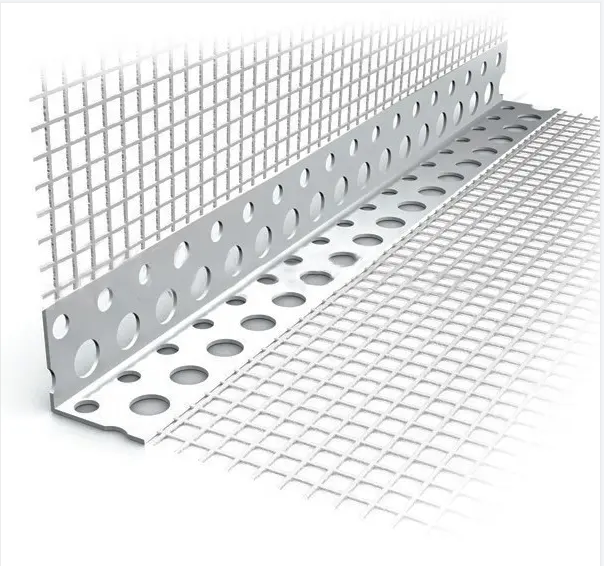
Evaluating how plastic profiles interact with wet trades dictates installation success. You must adapt your handling and fastening techniques to the material. Treating plastic exactly like metal leads to poor adhesion and warped corners.
Cutting plastic requires different tools than metal. You use standard aviation snips. The cut is clean and instantaneous. Metal leaves jagged, rust-prone edges. Metal snips create airborne metal shards. PVC cuts safely without sparks or sharp burrs. Fastening methods also differ. You secure standard plastic beads with high-tack spray adhesive or staples. When using mesh-winged profiles, mechanical fasteners are often unnecessary. You embed the wings directly into the joint compound or render. This eliminates substrate penetration.
If you choose to use staples on standard PVC beads, you must use a specialized staple gun with a divergent point. The staples must sit flush with the plastic. Proud staples will catch your trowel and ruin the skim coat.
A PVC plaster corner bead integrates seamlessly with various wet materials. It works with standard gypsum board compound. It accepts heavy cementitious renders. It bonds with acrylic topcoats. Exterior insulation and finish systems (EIFS) require special attention. Cement-based base coats are highly alkaline. Standard fiberglass degrades in alkaline environments. You must verify that the attached mesh is alkali-resistant. This prevents the mesh from dissolving inside the render over time.
You also need to monitor the curing times of different renders. Cementitious renders shrink as they cure. The plastic bead will not shrink. If the render is applied too thick in a single pass, it can pull away from the plastic nose. Apply the render in controlled, even coats to manage this shrinkage.
Corner beads do not work in isolation. They must interface with window frame sealants. You must leave a precise gap between the bead and the window unit. You fill this gap with an approved elastomeric caulking. This creates a continuous, airtight barrier. It prevents drafts from entering the wall cavity. It stops hidden moisture tracking behind the plaster. Proper sill integration ensures water sheds outward, away from the interior framing.
Plastic expands and contracts with temperature fluctuations. You must account for these realistic tolerances. Extreme heat causes the bead to lengthen. If installed tight against a rigid surface, the bead will buckle. The plaster will crack. You must leave appropriate expansion gaps at the ends of long bead runs. A small gap allows the plastic to move freely. Flexible sealants absorb this movement without breaking the visual seal.
Never install PVC beads when the ambient temperature is below freezing. The plastic becomes rigid and difficult to cut cleanly. It also will not bond properly with spray adhesives in freezing conditions. Keep the materials in a conditioned space until you are ready to install them.
Smart procurement moves beyond the per-length price. Project managers must calculate the total cost of installation. Lifecycle maintenance dictates true value. Buying the cheapest bead on the market usually results in the most expensive wall.
Premium plastic beads carry a higher initial material cost than basic metal alternatives. Profiles with pre-attached mesh require complex manufacturing. This increases the upfront purchase price. However, the return on investment is rapid. Labor time decreases significantly. Faster cutting and easier handling speed up the job. Zero rust-related rework eliminates expensive return trips. Fewer warranty claims for cracked corners protect profit margins. The total installed cost of plastic is consistently lower than metal.
Vetting suppliers is critical for quality assurance. A reputable PVC corner bead manufacturer uses virgin vinyl. Virgin plastic provides superior UV stability. It maintains high impact resistance over decades. Cheaper alternatives use recycled plastics. Recycled vinyl often becomes brittle. It shatters during cutting or cold weather installation. Buyers must benchmark products against industry-standard premium vinyl beads. Profile consistency is non-negotiable. The nose must be perfectly straight.
Quality control extends to the mesh attachment. Manufacturers use ultrasonic welding to fuse the mesh to the plastic. Poor welding causes the mesh to detach during troweling. You should request samples to test the weld strength of a fiberglass mesh corner bead before bulk ordering. The mesh must tear before the weld breaks. If the mesh peels off the plastic cleanly, the weld is defective.
Common Reveal Defect | Root Cause | Prevention Strategy |
|---|---|---|
Mesh Delamination | Dry-packing the mesh without wet mud behind it. | Always embed the mesh into a wet layer of base coat. |
Corner Bulging | Overlapping plastic flanges at 3-way intersections. | Miter the plastic flanges at 45 degrees so they sit flush. |
Bead Buckling | No expansion gap left at the end of the bead run. | Leave a 1/8-inch gap at the floor and ceiling. |
Rust Bleed-Through | Using metal beads in damp environments. | Switch entirely to PVC profiles for wet areas. |
Transitioning from metal to plastic introduces new variables. Installers commonly fail when they apply metal techniques to plastic products. Identifying these risks prevents site failures.
Three-way corners present a unique challenge. Window reveals often meet at complex angles. A major risk is overlapping the plastic noses at these intersections. Plastic is thicker than metal. Overlapping creates a massive bulge in the plaster. The trowel catches on the bump. Mitigation requires precise mitering techniques. You must cut the plastic flanges at exact 45-degree angles. The noses must meet flush without overlapping. This ensures a seamless, flat intersection.
Improper mesh embedment ruins the installation. The biggest risk is dry-packing. This occurs when installers staple the mesh dry to the wall, then apply plaster over it. The plaster does not penetrate behind the mesh. The mesh delaminates from the substrate. Mitigation requires the apply, embed, and skim technique.
Clean the substrate corner to remove all dust and debris.
Apply a generous layer of wet base coat directly to the substrate corner.
Press the mesh wings firmly into the wet mud.
Force the mud to squeeze through the mesh holes using your trowel.
Immediately skim over the top of the mesh with the trowel to smooth the surface.
Ensure 100% encapsulation of the fiberglass within the base coat.
Site storage impacts material performance. Plastic is susceptible to thermal warping. If left exposed to direct summer sunlight, the beads will bow. Uneven stacking causes permanent distortion. Mitigation requires strict site guidelines. Store all plastic beads flat on the ground. Keep them fully supported along their entire length. Always store them in shaded, cool areas prior to installation. Never lean them vertically against a wall for extended periods.
Metal beads have historical precedent, but plastic profiles are technically superior for window and door reveals. Their moisture immunity prevents rust. Their flexibility absorbs structural movement. Their impact tolerance eliminates permanent denting. Contractors should specify standard 90-degree profiles for interior drywall. They should mandate mesh-integrated profiles for heavy render systems. Exterior horizontal reveal heads always require drip profiles to manage water.
Audit your current reveal failure rates to identify rust or cracking trends on recent projects.
Request technical data sheets and physical samples from vetted manufacturers to verify virgin vinyl quality.
Conduct an on-site mock-up to train your crews on proper mitering and wet-embedding techniques.
Update your procurement specifications to strictly require alkali-resistant mesh for all exterior render applications.
A: Yes. You must ensure the plastic is UV-stable to prevent degradation from sunlight. If the bead includes mesh, the fiberglass must be alkali-resistant. Standard mesh will dissolve when exposed to the high alkalinity of wet cement render.
A: Use high-quality aviation snips or specialized plastic bead cutters. Make clean, decisive cuts. Never use a utility knife to score and snap the bead. Scoring creates micro-fractures in the plastic, which weakens the nose and leads to shattering during installation.
A: Standard paper or fiberglass tape offers zero impact resistance. A mesh-integrated bead provides a rigid plastic nose that absorbs blunt force. The attached mesh wings mechanically bridge the gap between the framing and the substrate, dissipating structural stress and preventing cracks.
A: Generally, no. Mesh beads are designed to be fully embedded into the wet base coat or adhesive. This wet-setting technique creates a stronger bond than staples. It also avoids penetrating the substrate, which maintains the integrity of exterior weather barriers.
A: It manages bulk water. The profile features a downward-facing lip installed at the top horizontal edge of an exterior opening. This lip breaks the capillary action of water, forcing it to drip straight down rather than tracking laterally into the window frame.
A: The initial material purchase price is generally higher for premium plastic profiles. However, the total installed cost is lower. Plastic cuts faster, requires less effort to haul, and completely eliminates expensive callbacks for rust bleed-through and dent repairs.


