
Views: 0 Author: Site Editor Publish Time: 2026-07-08 Origin: Site


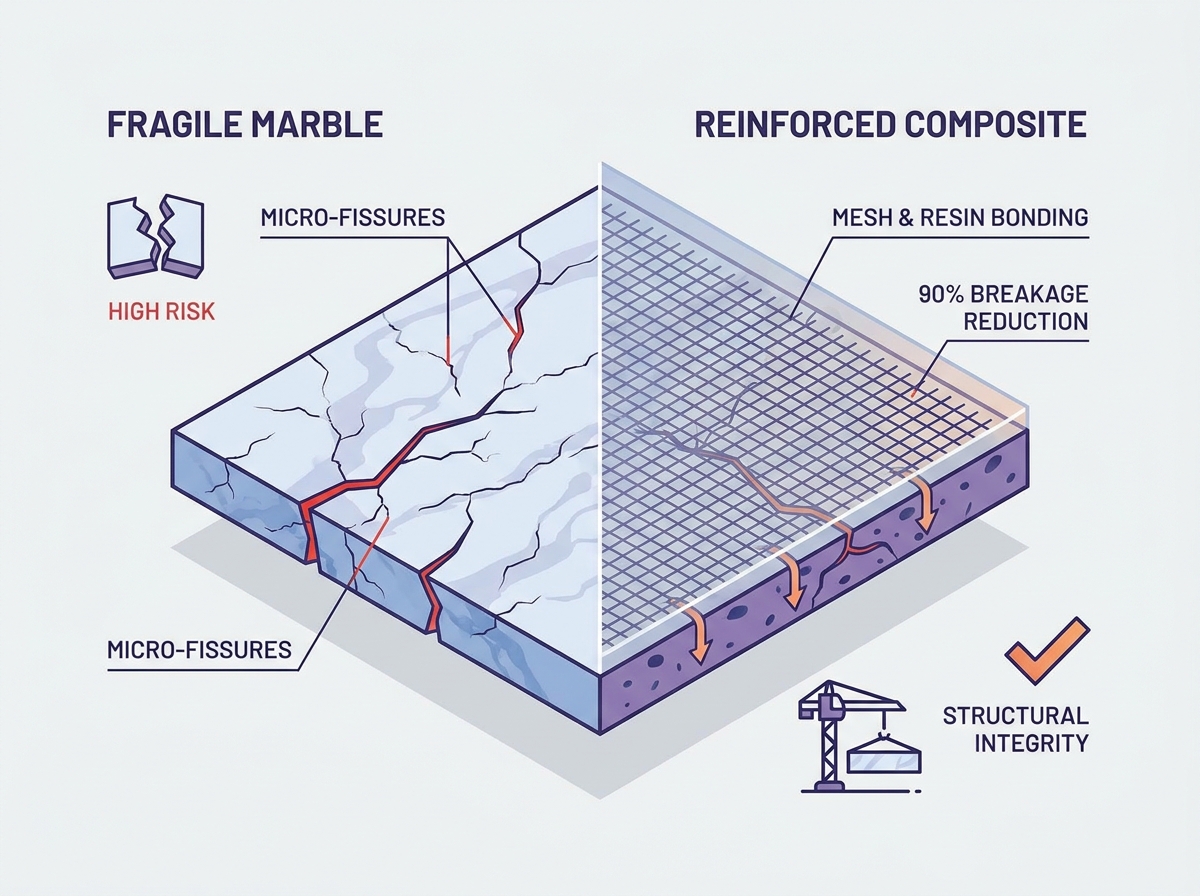
Natural stone possesses an undeniable, timeless beauty, yet its inherent fragility creates a serious liability for fabricators and installers alike. Heavily veined marbles, delicate onyx, and exotic breccias often contain hidden structural weaknesses. You must handle them with extreme precision to avoid catastrophic failures. Micro-fissures and natural fault lines frequently lead to sudden slab breakage during the fabrication process or cross-country transit. These unpredictable fractures cause severe raw material loss. They delay critical project timelines and ultimately compromise the structural integrity of the final installation.
Fortunately, the proper application of marble backing mesh completely transforms these fragile slabs into workable, high-yield materials. By reinforcing the stone's weak points, you significantly reduce handling risks. This guide explores the essential engineering standards, material evaluation criteria, and practical implementation realities required to select and apply reinforcement materials effectively. You will learn how to protect your premium stone investments through proper material science and strict process control.
Risk Mitigation: Applying a standardized stone crack prevention mesh reduces fabrication breakage by up to 90%, directly protecting profit margins on premium stone.
Material Compatibility: Not all mesh is equal; evaluating alkali-resistant coatings and specific weight-to-strength ratios is critical for long-term adherence.
Process is Paramount: Even the highest-grade high tensile mesh will fail if resin penetration protocols and curing parameters are not strictly controlled.
Supplier Scrutiny: Sourcing should be based on verifiable technical data sheets (TDS), consistent batch-to-batch quality, and alignment with industry standards (e.g., BSI recommended practices).
When a premium slab cracks, the financial impact cascades rapidly through your entire operation. Analyzing the compounding costs of a failure reveals a steep business liability. First, you lose the initial raw material investment. Exotic slabs carry massive upfront procurement costs. Next, you forfeit all previous fabrication labor. Hours spent on templating, cutting, and edge profiling instantly evaporate. Missed project deadlines damage your professional reputation. Furthermore, on-site replacement liabilities introduce massive unforeseen expenses. You must tear out the broken piece, source a matching slab, and re-fabricate everything under severe time constraints.
Natural stone faces immense dynamic loads during handling and transit. We must understand these mechanical stresses to mitigate them.
Crane Lifting: Vacuum lifters apply concentrated suction tension. The slab's edges bend downward under their own weight, creating intense tensile stress across the center.
A-Frame Transport: Trucking introduces continuous, high-frequency road vibrations. These micro-impacts exploit existing natural fault lines inside the stone.
CNC Machining: Router bits apply aggressive rotational friction. Plunge cuts introduce heavy downward pressure right over structurally weak veins.
Applying a baseline stone crack prevention mesh fundamentally shifts the failure point of the stone. Fragile natural materials become highly durable composite structures. The fiberglass netting absorbs and disperses kinetic energy across the entire slab surface. This composite behavior allows the stone to flex slightly without snapping. Ultimately, rigorous reinforcement processes prepare brittle architectural materials to withstand the rigorous demands of modern installations.
Weight versus tensile strength requires careful evaluation. We typically measure mesh density in grams per square meter (g/m²). Standard commercial slabs often use 60 to 75 g/m² netting. Highly fragile breccias might require 90 g/m² or higher. However, a heavier material does not automatically guarantee better results. You must balance the physical strength of the fabric against its ability to allow resin penetration. Thick, dense meshes block liquid epoxy from reaching the microscopic fissures below. The resin must flow freely through the woven apertures.
Alkali resistance stands as a non-negotiable chemical requirement. Installers frequently use cementitious thin-set mortars to bond the slab to the substrate. These mortars possess extreme alkalinity, often reaching a pH of 12 or more. Uncoated raw fiberglass degrades rapidly under these harsh alkaline conditions. The chemical attack dissolves the glass filaments, causing the backing to fail entirely. You must specify materials coated in high-quality acrylics or styrene-butadiene. This specialized protective layer ensures the marble fiberglass reinforcement maintains its long-term structural integrity.
Weave patterns heavily influence both flexibility and handling. Manufacturers typically offer leno weave and plain weave options. A leno weave intricately locks the warp and weft threads together. This interlocking design prevents yarn slipping during cutting processes. It also conforms easily to the microscopic undulations of a sawn slab back. Plain weaves often remain too rigid. A rigid mesh bridges over shallow dips on the stone surface. This bridging creates hidden air pockets, severely weakening the final epoxy bond.
Stone Density Category | Recommended Weight (g/m²) | Ideal Resin Viscosity | Typical Application Scenario |
|---|---|---|---|
High Density / Low Fissure | 60 - 65 g/m² | Medium to High | Standard granites and tight-grained marbles. |
Medium Density / Moderate Fissure | 70 - 75 g/m² | Medium | Heavily veined marbles and light quartzites. |
Low Density / High Fragility | 85 - 90+ g/m² | Low (High Penetration) | Exotic breccias, onyx, and deeply fractured stones. |
Proper surface preparation dictates the ultimate success of your reinforcement. Slabs arrive from the gang saw holding residual moisture and fine slurry. Dust prevents chemical adhesion by acting as a physical barrier. You must implement strict factory protocols to prepare the stone.
Moisture Evaporation: Run slabs through a high-temperature drying oven. You must eliminate all internal moisture, as water repels epoxy completely.
Surface Calibration: Lightly grind the back of the slab. This removes uneven saw marks and provides a consistent texture for bonding.
Micro-Dust Removal: Use industrial vacuums and compressed air. Eliminate all residual stone powder trapped inside the surface pores.
Resin and epoxy penetration techniques demand meticulous precision. The liquid resin performs a vital dual role. It must encapsulate the marble slab reinforcement mesh entirely to lock the fibers in place. Simultaneously, the liquid must soak deep into the stone's micro-fissures. Optimal penetration requires you to manage epoxy viscosity carefully. Many expert fabricators warm the stone slightly before application. Thermal expansion opens the microscopic pores, dramatically improving the capillary action of the resin.
Quality control and proper curing protocols prevent catastrophic failures. You must establish strict baseline QC checklists across your production line. Monitor your ambient factory temperature constantly. Maintain stable humidity levels, as excess moisture causes epoxy blushing. The resin requires specific, uninterrupted curing timeframes before you can handle the slab. Prematurely moving the stone stresses the uncured bond. This early movement causes invisible micro-delaminations across the fabric interface.
Delamination presents a massive operational risk in any fabrication shop. You might experience the frustrating reality of "peeling" mesh off the back of a slab. Many managers mistakenly view this as a simple manual error. In reality, it usually points to systemic chemical failures. Incorrect epoxy mixing ratios ruin the cross-linking adhesion. Incompatible resins react poorly against specific fabric coatings. Residual dust left on the slab stops the glue from grabbing the stone.
Let us contrast modern mesh application against traditional steel rodding. Fabricators historically embedded steel rebar into the stone for added strength. Industry professionals now acknowledge the severe risks of rebar rust. Over time, moisture eventually reaches the embedded steel. The steel oxidizes and expands up to four times its original volume. This massive internal expansion violently cracks the marble from the inside out. A modern high tensile mesh provides an inert, rust-proof alternative. It reinforces surface tension effectively without introducing internal swelling risks.
On-site adhesive compatibility creates another significant friction point. Factory-applied epoxy backs routinely reject standard thin-set mortar. Installers often struggle to bond cement directly to smooth plastic-like epoxy. You have highly reliable mitigation options available. Fabricators routinely broadcast coarse silica sand into the wet epoxy before it fully cures. This technique creates an aggressive mechanical key for the thin-set to grip. Alternatively, installers can brush specialized bonding primers directly over the cured epoxy prior to installation.
Sourcing materials demands rigorous technical scrutiny. You must demand verifiable Technical Data Sheets (TDS) from every prospective supplier. Look carefully for independent testing data. Verify their documented warp and weft tensile strength numbers. Demand actual proof of their alkali-resistance certifications. Never rely solely on marketing claims when structural integrity is at stake.
Roll consistency directly impacts your daily factory throughput. Straight-edged rolling prevents edge fraying during cross-country transit. Poorly packaged rolls quickly become deformed under their own weight. Telescoping edges snag easily on automated resining lines. This seemingly minor packaging flaw slows down your entire production schedule and wastes material. Proper storage in dry, temperature-controlled environments preserves the delicate coating integrity over time.
Assess the supplier's scalability and overall supply chain trust. Consistent quality across high-volume orders separates reliable partners from risky vendors. Request ample test samples before committing to a bulk purchase. Run rigorous in-house destructive testing on your specific stone materials. Cure the samples and conduct manual pull-off tests. Measure the exact force required to rip the fabric from the stone. Once you validate the data, you can safely transition your factory to a superior anti-crack stone mesh.
The true value of premium reinforcement lies far beyond the raw materials alone. Success depends entirely on your strict adherence to proven engineering standards and application protocols. Standardizing your approach transforms highly fragile, high-liability stones into predictably durable building components. This protects your raw material investments and eliminates costly on-site replacement scenarios.
To upgrade your operational stability, take these immediate actions:
Audit your current material inventory against documented TDS requirements.
Standardize your epoxy mixing ratios and oven-drying surface calibration protocols.
Implement mandatory in-house pull-off testing for all newly received material batches.
Transition entirely to alkali-resistant coatings to guarantee long-term installation stability.
A: Yes, standard materials can alter light transmission. However, you can preserve the natural translucency of onyx easily. You must select specialized, un-dyed white fiberglass. Pair this clear fabric exclusively alongside premium, UV-stable transparent epoxy. Dark or heavily colored meshes cast visible shadows through translucent stones. Always run a small visual mockup test before reinforcing full exotic slabs.
A: It depends entirely on the structural application. Mesh provides exceptional surface tension reinforcement. It stops micro-fissures from expanding during routine handling. However, it does not replace the structural load-bearing capacity of steel around fragile sink cutouts. You should combine both methods. Use mesh for overall slab integrity, and apply localized rodding for heavy overhangs.
A: Smooth epoxy strongly resists bonding against standard cementitious thin-set mortars. This creates severe delamination risks during final installation. You must bridge this chemical gap mechanically. Fabricators routinely broadcast coarse silica sand directly into the wet epoxy. This creates an aggressive texture. Alternatively, installers can apply specialized bonding primers over the cured epoxy safely.


