
Views: 0 Author: Site Editor Publish Time: 2026-07-10 Origin: Site


Natural stone fabrication presents a constant fundamental tension. Fragile stone slabs require robust structural reinforcement to survive global transport and handling. However, this exact reinforcement often creates severe installation liabilities, including catastrophic debonding and delamination. We evaluate the critical technical specifications of standard marble backing mesh systems to address these widespread challenges. Understanding how factory resin application impacts adhesive compatibility, waterproofing, and long-term installation stability is entirely essential today.
Poorly matched substrate materials frequently lead to expensive project failures. We will guide you through balancing tensile strength and flexibility for various stone types. Our goal is to provide fabricators, contractors, and architectural specifiers a vendor-neutral, evidence-backed framework. You will learn exactly how to select, prepare, and install resin-reinforced stone substrates. Applying these methods ensures complete confidence in your final architectural installations.
Material Specs: High-quality marble backing mesh relies on alkali-resistant fiberglass woven at specific densities (typically 60–80 g/m²) to balance tensile strength with flexibility.
Compatibility Risk: The primary cause of failure in resin-backed stone is the incompatibility between cementitious thin-set mortars and non-porous resin layers; mechanical bonding requires specific primers or epoxy adhesives.
Moisture Resistance: Utilizing a true waterproof stone backing mesh prevents fiberglass degradation and efflorescence in high-moisture environments (e.g., wet rooms, exterior facades).
Installation Protocol: Fabricators must conduct pre-installation pull-tests to determine if the mesh requires mechanical removal or chemical priming prior to setting.
Manufacturers produce reinforcement netting across multiple weight categories. They measure this density in grams per square meter (g/m²). Standard slabs utilize weights between 60 g/m² and 80 g/m². Heavier stones might require netting exceeding 100 g/m². Weave aperture size plays an equally critical role. The mesh hole size dictates optimal resin penetration. Smaller holes provide tighter structural rigidity. However, smaller apertures sometimes prevent resin from reaching the stone surface properly. Larger holes allow deeper resin saturation. This deep saturation creates a stronger bond between the fabric and the stone face.
Density Category | Weight Range (g/m²) | Typical Application | Flexibility Profile |
|---|---|---|---|
Lightweight | 40 - 55 g/m² | Small format mosaics, soft limestones | High flexibility, low rigid support |
Standard | 60 - 80 g/m² | Standard 2cm marble and granite slabs | Balanced rigidity and thermal give |
Heavy-Duty | 90 - 120+ g/m² | Fragile onyx, deeply veined 3cm slabs | Maximum tensile strength, minimal flex |
You must balance tensile strength and flexibility carefully. High tensile strength prevents slab fracturing during intense ocean transit. It holds natural fissures tightly together. Yet, you cannot render the stone entirely rigid. Slabs undergo continuous thermal expansion and contraction after installation. An overly rigid reinforcement layer restricts this natural movement. The restricted movement eventually causes shear stress at the bond line. The best materials offer slight elastic deformation. They absorb transport shocks while accommodating normal building shifts over decades.
Standard raw fiberglass degrades rapidly when exposed to high pH environments. Cementitious adhesives produce extremely alkaline conditions during their curing phase. Unprotected fibers literally dissolve under these harsh chemical loads. This degradation compromises the structural integrity of the stone over time. Premium reinforcement uses specific chemical coatings to survive. These alkali-resistant barriers block cement-induced corrosion. They guarantee the netting remains fully intact inside the mortar bed indefinitely.
Factories monitor the strict resin-to-fiberglass ratio during production. Ideal saturation fully encapsulates every woven strand. Uneven coating processes lead to significant weak points. Dry spots occur where fibers receive insufficient liquid binding. These dry zones fray easily during cutting procedures. Conversely, excessive pooling creates thick plastic lumps on the slab back. These uneven lumps prevent the stone from laying flat against the wall. They also trigger localized debonding because adhesive cannot grip thick, smooth plastic ridges.
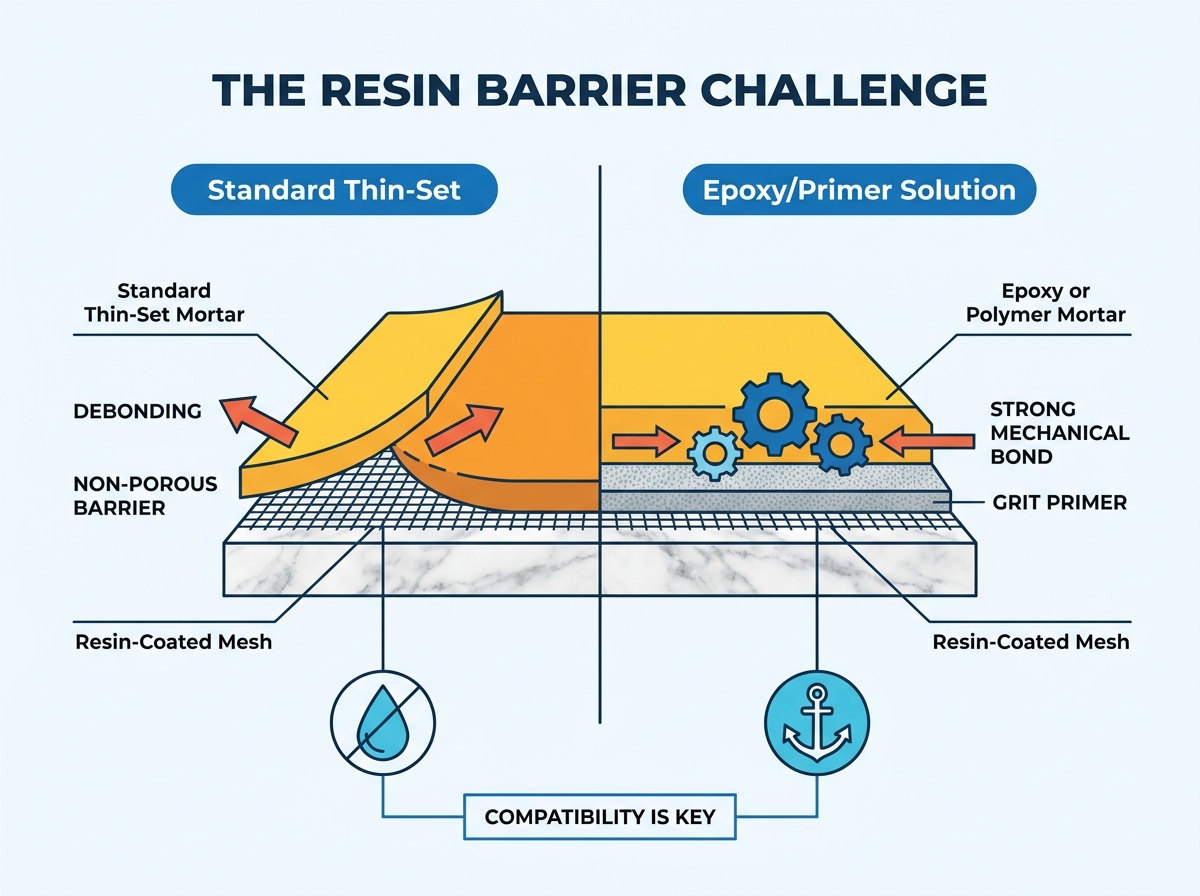
Resins inherently create a smooth, non-porous surface. Standard modified or unmodified cementitious mortars rely on porosity to function. They require tiny capillary pores to achieve a proper chemical bond. Resins block these crucial pores completely. Cement simply cannot bond chemically to a sealed plastic barrier. You will face inevitable tile failure if you ignore this reality. The mortar cures, but it never grips the slab. Gravity and thermal shifts will eventually pull the stone off the wall.
The global fabrication industry relies heavily on polyester resin mesh. It offers excellent cost-effectiveness for bulk slab processing. It reinforces fragile veins successfully during polishing. However, you must understand its installation drawbacks. Polyester tends to block moisture transmission entirely. Standard mortars fail against it. You must utilize specialized grit-based primers to install these slabs. Acrylic primers containing suspended silica sand create artificial surface texture. This rough texture allows cement to achieve a necessary mechanical grip.
High-end installations demand superior chemical alignment. You should consider specifying an epoxy compatible mesh for demanding environments. This premium alternative eliminates bonding uncertainty. It pairs seamlessly with 100% solids epoxy adhesives. These adhesives comply strictly with ANSI A118.3 standards. The epoxy adhesive chemically melts into the epoxy-based reinforcement. This fusion creates an unbreakable monolithic layer. It provides maximum shear bond strength for heavy vertical installations and complex overhead architectural details.
Contractors face confusion when handling reinforced slabs on site. We provide a clear framework for making immediate installation decisions. Follow this systematic approach to determine your bonding strategy:
Inspect the Factory Bond: Attempt to pull the netting away from the stone corner using pliers.
Evaluate Adhesion Strength: Observe how easily the fabric separates from the natural stone surface.
The Peel Protocol: If the resin is poorly bonded and strips away cleanly, you must grind it off completely. Mechanical removal exposes raw stone for standard thin-set adhesion.
The Prime Protocol: If the material is securely bonded and tears rather than peels, leave it intact. You must then apply specialized silica-grit primers or transition to a full epoxy thin-set.
Standard woven fiberglass acts exactly like a wick. It draws liquid continuously through capillary action when exposed to water. This moisture migration travels deep behind the stone face. It causes severe visual and structural damage over time. Moisture trapped behind light-colored marble causes distinct yellow discoloration. It also dissolves mortar minerals, bringing them to the surface. This creates ugly white efflorescence stains across your grout lines. You must interrupt this wicking behavior in wet environments.
Manufacturers engineer solutions specifically for moisture-heavy environments. A true water-resistant fiberglass mesh meets rigorous testing criteria. Factories apply specialized hydrophobic resin coatings during production. These advanced liquid coatings seal individual silica fibers entirely. They close the microscopic gaps between woven threads. The finished netting repels water rather than absorbing it. This critical barrier ensures the reinforcement layer remains dry, stable, and rot-free regardless of ambient humidity.
Certain architectural zones make moisture protection absolutely non-negotiable. Commercial shower enclosures require these advanced materials. Daily water deluge penetrates standard grout joints easily. Exterior natural stone facades face constant rain and extreme freeze-thaw cycles. Pool copings endure aggressive chemically treated water splashing constantly against them. Using standard untreated reinforcement in these aggressive environments guarantees premature failure. Always specify verified moisture-repellent materials for these high-risk application fronts.
We must clarify a vital technical distinction regarding material performance. Utilizing a waterproof stone backing mesh protects the structural integrity of the slab itself. It prevents internal fiber rot and localized stone warping. However, it does not act as a primary room seal. It does not replace the need for a secondary waterproofing membrane on the wall substrate. Contractors must still apply liquid-applied membranes or sheet membranes over the cement board before setting the stone.
Theoretical compatibility means nothing without field verification. We emphasize the absolute necessity of performing localized bond tests. Contractors must conduct these tests before full-scale project deployment. Apply your intended mortar and primer combination to a scrap piece of the reinforced stone. Allow it to cure fully according to manufacturer guidelines. Attempt to pry the cured mortar off the slab. If the mortar releases easily, your chemical system is incompatible. You must adjust your materials before proceeding.
Using adhesion promoters requires strict adherence to environmental controls. Advanced synthetic resin primers contain suspended silica aggregates. These primers demand specific curing times before you can apply thin-set over them. Ambient temperature dictates this curing speed heavily. Cold environments extend drying times significantly. Applying wet mortar over uncured primer destroys the mechanical bond instantly. You must ensure proper ventilation and temperature control. Always wait for the primer to turn completely translucent and hard to the touch.
Ignoring surface preparation transfers massive financial liability directly to the installer. Adhesive manufacturers publish strict Technical Data Sheets (TDS). These documents outline exactly how to handle non-porous substrates. Many manufacturers explicitly void their product warranties if standard cementitious thin-set is applied directly to a resin-coated marble mesh. They require approved surface preparation, such as grit priming or epoxy substitution. Failing to follow these published rules leaves you completely unprotected during a catastrophic wall failure claim.
Slab preparation begins long before mixing the mortar. Slabs backed with heavy polymer layers respond uniquely to environmental stress. They can warp significantly if stored improperly. Asymmetrical thermal loads pull the stone out of plumb.
Always store reinforced slabs perfectly vertical on A-frames.
Keep materials out of direct, uneven sunlight prior to installation.
Allow slabs to acclimate to the interior room temperature for 48 hours.
Never lean flexible slabs against uneven job site debris.
Sourcing reliable substrate materials demands rigorous vendor scrutiny. You cannot accept generic marketing claims regarding structural performance. You must request specific documentation from potential suppliers. Ask for independent tensile strength test reports. Demand official alkali-resistance certifications to ensure longevity in cementitious environments. Verify their ISO compliance manufacturing standards. Vendors who cannot produce immediate laboratory documentation frequently use inferior, untreated raw glass fibers. These untreated fibers will fail on your job site.
Factory audits reveal massive disparities in coating quality. You must learn how to spot manufacturing defects during material inspections. Look closely at the surface consistency. Frequent dry spots indicate poor factory calibration. Excessive liquid pooling creates unworkable ridges on the stone back. Watch out for badly fraying edges along the cutting lines. These defects indicate cheap binding agents. A premium product will exhibit a uniform, smooth, and fully encapsulated grid structure across the entire slab footprint.
Large commercial projects require absolute material uniformity. Assessing a vendor's ability to maintain exact specifications across high-volume container orders is critical. A manufacturer might produce a perfect initial sample but fail during bulk production. Their machinery might lose calibration over thousands of square meters. Ensure your chosen vendor has automated tensioning and coating lines. Automated lines guarantee the 10,000th meter of fabric performs exactly like the first meter. Predictable scalability prevents mid-project installation crises.
The specification of stone reinforcement is far more complex than simple logistics. It is not merely a transport protection decision designed to survive shipping containers. It functions as a permanent structural component that dictates your entire installation methodology. The materials you choose in the factory impact everything from trowel feel to multi-decade durability.
Mitigating job site risk requires careful technical alignment. You must perfectly align the mesh type, the resin chemistry, and the final installation adhesive system. A failure in one of these three layers causes the entire wall assembly to fail. We direct all specifiers and fabricators to act proactively. Consult closely with both the netting manufacturer and your adhesive provider. You must confirm complete chemical compatibility before finalizing your material schedules and breaking ground.
A: If the mesh is firmly adhered with a high-quality resin, it typically stays on but requires a specialized primer or epoxy adhesive. If the mesh is peeling or poorly bonded, it must be mechanically ground off to ensure the adhesive bonds directly to the stone.
A: No. Standard thin-set requires a porous surface to cure and bond chemically. Resin creates a waterproof barrier, requiring either an epoxy adhesive or a grit-applied primer to create a mechanical bond.
A: Alkali-resistant mesh is coated with a specific protective polymer (like acrylic or styrene-butadiene) that prevents the harsh alkaline environment of cement-based mortars from dissolving the fiberglass strands over time.
A: Epoxy provides vastly superior bond strength and moisture resistance, making it ideal for high-stress or wet environments. Polyester is more economical and common for general transit reinforcement but requires more rigid installation workarounds.


